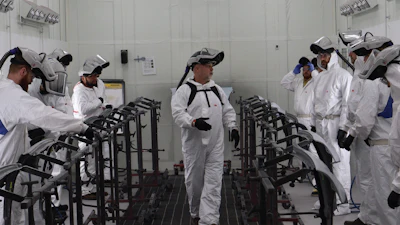

CANADIANS VISIT 3M SKILLS DEVELOPMENT CENTER

The 1,394-square-metre (15,000-square foot) facility opened in October 2023. The first classes actually began in June 2023. Seventy percent of the space is dedicated to workshop environments.
At the heart of the centre sits a 10.7-metre (35-foot) GFS XL paint booth with three-stage filtration. It’s one of the largest automotive paint booths available and can accommodate 16 painters at once. The facility also includes 24 workstations equipped with electrical and air service drops and a dozen welding stations, each with its own fume extraction hood.
The centre occupies land that housed 3M’s first operations outside Duluth and Two Harbors. This marks more than a century of the company’s connection to St. Paul and the collision repair industry. Four Minnesotabased artists — Adam Turman, Rock ‘CYFI’ Martinez, Biafra and Wundr — created murals throughout the facility that reflect 3M history, local culture and the technicians the centre serves.
The course began with paint shop fundamentals. Participants started with proper personal protective equipment requirements before moving to quality checks that ensure vehicles are ready for the booth.
The focus then shifted to hands-on work. Technicians practiced feathering, priming and blocking techniques — foundational steps that determine final paint quality. Throughout the day, instructors reinforced how prep decisions directly affect downstream results.
“In paint and refinish, small mistakes compound quickly,” said trainer Troy Knopik. “We stress that prep work isn’t just preparation — it’s the foundation of the entire repair. If it’s rushed or skipped, it shows in the final product.”
Primer application occupied much of the remaining time on the first day. Technicians practiced different techniques for various repair scenarios. The group also worked through full-vehicle masking exercises that emphasized efficiency, material selection and cleanliness.
Day two moved participants back into the booth. The morning covered booth setup, spray gun adjustment and textured coating applications. From there, the course dove into colour selection, colour theory and tinting — topics that have grown increasingly complex as OEM finishes evolve.
“Matching colour today isn’t just about finding the right code,” said trainer Mike Nelson. “It’s understanding variants, lighting, spray technique and how all of that works together. We want technicians to leave confident in their decision-making, not guessing.”
The afternoon sessions focused on application work. Technicians spent extended time practicing sealer, basecoat and clearcoat techniques. The goal was building consistency and repeatability — critical skills when paint jobs need to meet OEM standards. Like the first day, this session concluded with a Plus/Delta evaluation. Participants reflected on what worked and what didn’t, discussing how those lessons would apply back at their shops.
The final day addressed even more paint application opportunities, including blending, spot repair, as well as the finishing stages of paint work. Participants practiced blend techniques and spot repair methods, with an emphasis on achieving invisible repairs that match factory finish standards.
The course wrapped up with sessions on booth efficiency and buffing. These showed participants how to maximize throughput without sacrificing quality — a balance that defines successful paint departments. Training extended beyond the classroom and shop floor. On Thursday evening, the group attended an NHL game between the Minnesota Wild and Dallas Stars. The outing gave technicians time to build relationships and continue conversations that started during the day’s sessions.
“Training like this isn’t just about the tools or the products,” MacNeil said. “It’s about bringing people together, sharing best practices and raising the bar across the region. When these technicians go home, that knowledge goes with them — and it makes the industry stronger.”
The Skills Development Centre represents 3M’s response to growing workforce challenges in collision repair. Since opening, the facility has hosted thousands of technicians, front office professionals, shop leaders, distributors, paint companies, OEMs, industry trade groups, and high school and college students, amongst others, across nearly two hundred classes and events. Participants have come from nearly every US state and Canadian province, with nearly 80 percent traveling. Three core programs classes anchor the curriculum: body repair, and paint preparation/refinishing, and hands-on, front office (~estimator) training. Two of the three classes also include I-CAR® credits. Each summer, vocational-technical instructors from across North America attend week-long intensive courses covering OEM repair procedures.
The centre’s instructors bring more than 125 years of combined industry experience, including years on the shop floor. Their courses emphasize OEM-approved repair procedures at a time when the industry faces a projected shortage of over 100,000 collision repair technicians by 2026. Industry research shows 34 percent of shop owners cite finding qualified technicians as their biggest challenge.
The hands-on training complements 3M’s online Collision Repair Academy. Together, they help technicians stay current as vehicle technology and repair requirements continue to evolve. The facility’s modular layout allows it to adapt to different training needs and student groups, ensuring it can meet the industry’s changing demands.
flickr.com/photos/40043123@N05/with/54985872881
collisionrepairmag.com/15774925