Adhesives are essential in collision repair for bonding vehicle panels and repairing plastic components, with different formulations designed for specific materials, applications, and performance requirements including structural bonding, plastic repairs, and compatibility with manufacturer repair procedures.
- Structural adhesives are engineered for applications where bonded joints form part of the vehicle's structure and may be used alongside welding or other joining methods.
- Plastic repair adhesives must match the specific composition of plastic components, as products suited to one type of plastic may not work for another.
- Adhesive performance varies in flexibility, impact resistance, working time, and curing characteristics depending on intended use and material compatibility.
- Vehicle manufacturers' repair procedures determine which adhesives are approved and suitable for specific makes and models.
- An adhesive's suitability depends on material compatibility and intended application rather than general strength claims or product descriptions.
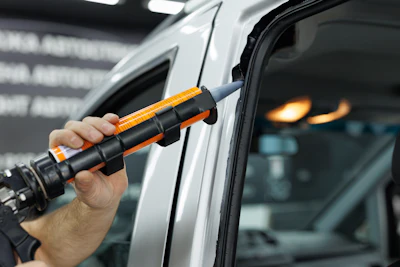
Adhesives play a role in several areas of collision repair, from bonding vehicle panels to repairing certain plastic components. As vehicle construction has evolved, so has the range of adhesives available, which are formulated for specific materials, applications and performance requirements.
Structural adhesives are designed for applications where a bonded joint forms part of the vehicle’s structure. Depending on the manufacturer’s repair procedures, they may be used alongside welding or other joining methods. These products are developed to meet specific strength and durability requirements, setting them apart from adhesives intended for less demanding applications.
Plastic repair adhesives account for another part of the category. Plastic components vary in composition and properties, so a product suited to one type of plastic may not be suitable for another. Some adhesives are formulated for particular substrates, while others can bond different materials. The range reflects the variety of plastics found in vehicle bumpers, exterior trim and other components.
The materials being joined are only part of the equation. Adhesives can differ in flexibility, impact resistance, working time and curing characteristics. Some are designed to maintain a strong bond when materials experience movement or vibration, while others are formulated for specific structural applications. These differences influence the performance a product can deliver in its intended setting.
Vehicle manufacturers’ repair procedures also shape the adhesives used in collision repair. As designs and material combinations vary across makes and models, product specifications and approved applications can differ. An adhesive’s suitability depends on its intended use and compatibility with the materials involved, rather than simply its general description or advertised strength.
The adhesives market continues to serve a broad range of repair requirements, with products developed for structural bonding, plastic repairs and other specialized applications. Differences in formulation, material compatibility and performance make adhesives a distinct category within collision repair, with options designed for the varied construction and repair demands of today’s vehicles.