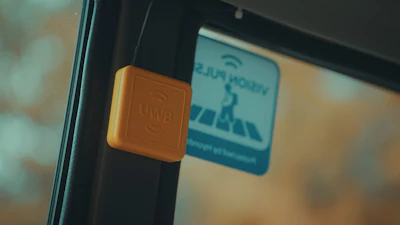
Hyundai Motor Company and Kia Corporation have unveiled Vision Pulse, a new driver safety technology designed to detect vehicles, cyclists and pedestrians beyond a driver’s line of sight using ultra-wide band signals.
The technology uses UWB modules installed in vehicles to emit signals and measure the time it takes for those signals to travel between nearby objects equipped with compatible modules, including certain smartphones, wearables and trackers. That data allows the system to calculate precise object positions in real time and issue collision alerts when necessary.
According to the companies, Vision Pulse can detect objects within a 100-metre radius with accuracy down to 10 centimetres, even in visually obstructed environments such as urban intersections. Detection accuracy remains above 99 percent in adverse weather or nighttime conditions, with communication speeds ranging from one to five milliseconds.
Vision Pulse is designed to reduce reliance on expensive sensors such as LiDAR and radar by using UWB modules already integrated into many vehicles. Models equipped with Hyundai Motor and Kia’s Digital Key 2 require no additional hardware to support the system.
The companies have also developed predictive algorithms capable of tracking multiple high-speed moving objects, expanding the technology’s real-world usability. Beyond passenger vehicles, Vision Pulse is being tested in industrial environments and emergency-response scenarios, including collision prevention in warehouses and locating individuals trapped under debris.
Pilot programs have been underway since 2025 at Kia’s PBV Conversion Center in Hwaseong, South Korea, with additional trials planned at Busan Port following an agreement signed in October.
Vision Pulse remains a pre-development technology, with potential applications for mass-production vehicles still under consideration.