
Ford is announcing a new in-house vehicle electronics architecture designed to simplify hardware, reduce costs and support software-defined vehicles across its lineup.
The technology was announced at CES (formerly the Consumer Electronics Show) — an annual global technology conference held each January in Las Vegas.
The automaker’s approach focuses on consolidating numerous electronic control units into a smaller number of high-performance computing modules developed internally. Ford indicated the strategy is intended to improve processing speed, lower per-vehicle costs and enable new digital features to be deployed more consistently at production scale.
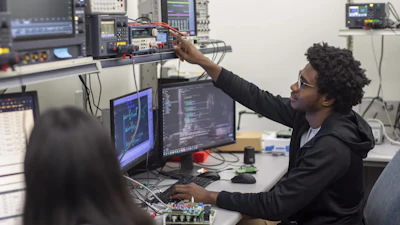
An internal electronics team, established roughly seven years ago, has driven the shift. Many team members previously worked in the mobile phone industry before adapting that experience to automotive requirements, including functional safety and long-term reliability. Ford reported the group has produced approximately 35 million modules to date, with current production operating at roughly 10 million units per year.
According to the automaker, bringing electronics development in-house has allowed it to reduce the total number of physical modules per vehicle while generating cost savings of about 10% to 15% per module. Ford stated those savings are being reinvested into expanding internal engineering capabilities.
At CES, Ford also introduced its high performance computer centre, an in-house module intended to serve as the foundation of its future vehicle architecture. The unit integrates infotainment, advanced driver assistance systems, audio and networking into a single component, delivering higher performance in a package nearly half the size of previous solutions.
The computer centre will support Ford’s upcoming Universal Electric Vehicle architecture, which increases the automaker’s control over key semiconductors by five times. By combining IVI and ADAS functions on a single platform, Ford aims to reduce system complexity while creating a standardized electronics foundation across its vehicle portfolio.
The announcement outlines Ford’s plans to further centralize vehicle electronics by combining infotainment and advanced driver assistance systems within a single computing module.