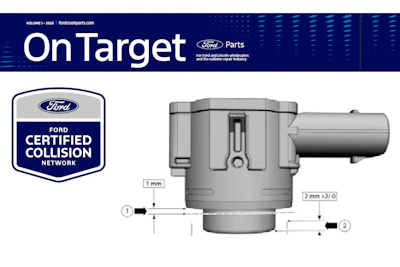
The Ford Motor Co. is setting limits on how parking aid sensors can be refinished, according to its latest On Target technical bulletin, released April 13.
On Target, the OEM's publication for collision repairers, outlines approved procedures, material specifications and repair. The latest bulletin establishes a defined process for painting parking sensors used in advanced driver assistance systems, including a maximum total coating thickness of 115 microns across all layers.
It also mandates that new sensors must not be sanded or scuffed prior to refinishing, and units that have already been painted must be replaced rather than refinished again.
Paint application has also been limited to the sensor face and may extend no more than 4 mm from the front edge. The procedure requires removal of the isolator ring, cleaning with isopropyl alcohol and immediate drying before coating. Paint intrusion into the electrical connector is not permitted, and immersion cleaning is prohibited.
Curing is capped at 90 C for one hour. The bulletin also specifies coating ranges by layer to maintain sensor performance within defined tolerances.
“Researching the repair ahead of time utilizing the WSM will make for a much more efficient repair,” said Gerry Bonanni, senior damageability engineer at Ford, referring to the company’s workshop manual. He added that the manual is “continuously updated,” with procedures that may change or be added over time.
The same issue outlines revised rear-rail repair procedures for the Ford Explorer, introducing three sectioning options based on damage extent: 212 mm, 410 mm and 570 mm. Damage beyond 570 mm requires full rail replacement.
Bonanni described full rail replacement as “very invasive, time-consuming and expensive,” noting the updated sectioning method was developed to help prevent vehicles from being written off as total losses.
Repair guidance for the Explorer specifies targeted weld removal, use of pilot holes to reduce drilling time and consideration of high-strength boron steel in the rail, which increases resistance during cutting and drilling. Adhesive separation should be performed using a panel separation tool rather than heat.
The bulletin also details body construction for the Ford Escape, identifying aluminum alloy, mild steel, high-strength low-alloy steel, dual-phase steel and boron steel across structural components including the hood, front side member, radiator support and dash panel reinforcements.
The material breakdown is intended to guide repair method selection, including welding, brazing, bonding or replacement, depending on substrate.
Key points
* Ford sets 115-micron maximum coating thickness for parking sensors
* Previously painted sensors must be replaced
* No sanding or scuffing permitted before refinishing
* Paint limited to sensor face, maximum 4 mm wrap
* Maximum cure temperature: 90 C for one hour
* No immersion cleaning; no contamination of electrical connector
* Explorer rear rail sectioning options: 212 mm, 410 mm, 570 mm
* Damage beyond 570 mm requires full rail replacement
* High-strength boron steel affects drilling and repair approach
* Adhesive joints should be separated without heat
* Escape construction includes aluminum, HSLA, dual-phase and boron steels
* Workshop manual procedures subject to ongoing updates