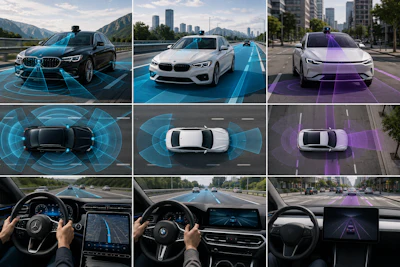
OEM ADAS systems may share names, but the technology behind these systems can vary sharply between automakers.
The article, Comparative Review of Commercialized Advanced Driver Assistance System (ADAS) Technologies, was published May 9, 2026 in Electronics. The review covered commercial ADAS technologies across 11 major Western and Asian automakers: Mercedes-Benz, BMW, Volkswagen, Ford, General Motors, Tesla, Hyundai, Toyota, XPeng, Li Auto and NIO.
The article’s abstract describes ADAS as “a crucial transitional technology” toward fully autonomous driving. It says the systems improve safety and comfort through functions such as emergency braking, lane-keeping and adaptive cruise control, while aiding in “traffic accident prevention” and reducing “driver fatigue.”
But the systems are far from uniform. The authors write that “similarly named functions such as highway assist, lane-centering assist, or hands-free driving can differ substantially” in sensing redundancy, map dependence, operational design domain boundaries, activation conditions, driver-monitoring requirements and fallback or takeover logic.
Put simply -- the name of an ADAS feature does not tell the whole story. A feature name alone may not tell drivers, repairers or insurers what sensors the system uses, where the system can operate, when it shuts off, how closely the driver must watch the road or what happens when the vehicle needs the driver to take over.
The article gives a clear example. A highway-assistance function, a hands-free Level 2 function and a conditionally automated Level 3 function may all help control speed and steering. But they can still differ in where they are allowed to operate, how closely they monitor the driver, how much time they give the driver to take over and what the vehicle does if the driver does not respond.
Mercedes-Benz DRIVE PILOT is described as an SAE Level 3 system available on the S-Class and EQS sedan. Its setup includes cameras, RADAR, LiDAR, ultrasonic sensors, a road-moisture sensor, antenna-based positioning and HD mapping.
The article says DRIVE PILOT is limited to specific motorway sections under defined environmental and traffic conditions. It may become unavailable in adverse weather, reduced visibility, tunnels, ramps or other conditions outside its declared operating area.
BMW shows how much can vary within one automaker’s lineup. The article identifies BMW Highway Assistant as SAE Level 2 and BMW Personal Pilot as SAE Level 3. Personal Pilot is limited to highways without intersections, uses Live HD Maps and is limited to 60 km/h or less. Highway Assistant is for controlled-access highways and supports hands-free driving at speeds up to about 137 km/h, while the driver must remain attentive and ready to take control.
Volkswagen Travel Assist is described as an SAE Level 2 system using cameras, RADAR, ultrasonic sensors, GPS and navigation data. The article says it supports steering, braking and acceleration assistance from about 30 km/h to 210 km/h within system limits. In the swarm data-based version of Travel Assist, assisted lane changes are described as available on multi-lane highways at speeds above 90 km/h.
Hyundai Highway Driving Assist 2 is also Level 2, but it has its own limits. The article says HDA2 is limited to controlled-access roads such as highways or expressways without intersections. It may be limited or deactivated when sensors are degraded, lane markings are hard to detect, map or GPS information is unavailable or inconsistent with the road, or road conditions temporarily change because of construction zones.
Tesla takes a different approach. The article says Tesla Autopilot relies mainly on cameras and does not rely on HD maps, although some functions may use navigation and route data. It says Tesla Vision processes data from eight external cameras that provide a 360-degree view up to 250 m. Autosteer is generally supported up to 140 km/h, while FSD (Supervised) is designed to support driving on almost any route under active driver supervision.
Ford and General Motors use another approach. The article describes Ford BlueCruise and GM Super Cruise as Level 2 hands-free systems that depend on mapped roads. They allow hands-free operation only on compatible or pre-mapped roads and use driver-attention monitoring to keep the driver responsible for watching the road.
The article contrasts those systems with map-light or map-free systems from XPeng, Li Auto and NIO. XPeng’s XNGP is described as a Level 2 system for highway and urban assisted-driving scenarios that uses cameras, LiDAR, RADAR and ultrasonic sensors and is designed to operate without HD maps. Li Auto’s Li AD Max is described as a supervised Level 2 system whose NOA coverage has expanded from highway scenarios into broader urban road use through OTA software updates. NIO’s NOP+ is also described as Level 2, with OTA updates used to refine system functions, perception capability and feature coverage.
The authors do not argue that one approach is best.
Instead, the article says the comparison does not support a simple conclusion that more sensors, broader operating areas or faster software updates make a system better. The key issue is whether the sensors, operating limits, driver monitoring and backup procedures work together clearly and consistently.
The paper also avoids ranking automakers by safety. Its authors write that the review compares implementation-level characteristics, not quantitative safety performance. They also state that the study does not claim any reviewed automaker system is statistically safer than another.
The article identifies three broad challenges: inconsistent communication about where systems can operate, inconsistent driver-monitoring and takeover procedures and limited independent validation data.
It also proposes six improvement directions: clearer consumer-facing communication about operating limits and system status, more consistent in-vehicle warnings and takeover requests, stronger independent validation, review frameworks that account for software updates, future consideration of connected infrastructure and separate evaluation of ADAS for commercial vehicles.
The article was written by Yeongmin Kim, Sohyang Kim, Doyeon Kim and Kibeom Lee, mechanical engineering researchers at Gachon University in Seongnam, South Korea.