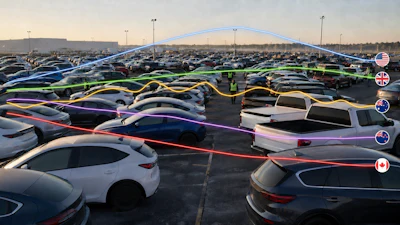
Canada's used vehicle market is experiencing a steeper annual decline of 7.7% compared to more modest declines in the United States and United Kingdom, driven by longer-lasting wholesale depreciation and shifting buyer preferences toward fuel-efficient compact cars over larger SUVs and pickups.
- Canadian wholesale values fell 7.7% year-over-year, substantially more than US and UK markets which showed smaller declines
- The Canadian Black Book Used Vehicle Retention Index dropped to 127.9 in July, with compact cars gaining 0.35% while SUVs lost 0.71%
- Average dealer listing prices in Canada sit at approximately $36,900 as economic predictability reduces market volatility
- Electric vehicles outperform traditional vehicles in all markets, with US EV values up 10.5% and UK used EV prices rising 3.3% annually
- Buyers across all markets are prioritizing affordable, fuel-efficient vehicles, causing larger SUVs and pickup trucks to face greater depreciation and longer selling times
Canada's used vehicle market is declining faster than its peers.
Used-vehicle values have softened across several major markets, but Canada’s annual decline is substantially greater than those recorded in the United States and United Kingdom.
Canadian correction
Canadian wholesale values have continued to fall while the American market remains close to last year’s level.
The Canadian Black Book Used Vehicle Retention Index declined from 128.0 in June to 127.9 in July. The index was down 7.7% year over year. Canadian Black Book is a Toronto-based vehicle valuation and residual-value data provider. Its index covers two- to six-year-old vehicles sold at wholesale.
The monthly movement was small, but the annual comparison indicates that the Canadian correction has lasted much longer than the American spring decline. Compact cars gained 0.35% during the final full week of July, while midsize cars fell 0.59% and full-size crossovers and SUVs lost 0.71%. The average dealer listing price was approximately $36,900.
“We are not necessarily seeing a positive outlook, but rather one that signals less volatility than in previous months,” said Daniel Ross, director of strategic market insights at Canadian Black Book.
Ross said wholesale depreciation was returning to more traditional weekly rates as interest rates, unemployment and other economic conditions became more predictable.
Spring reversal
American wholesale prices have relinquished much of their early-2026 increase.
The Manheim Used Vehicle Value Index fell 1.4% in July to 210.0. It remained 1.3% above July 2025, but a preliminary mid-August reading of 207.4 was essentially unchanged year over year. Manheim is the wholesale auction division of Atlanta-based automotive data and services provider Cox Automotive.
Three-year-old vehicle prices fell 2.8% in July. Sales conversion declined 2.2 percentage points from June, while wholesale supply increased to 28 days. Increasing off-lease returns are providing dealers with additional late-model inventory while reducing competition for some vehicles.
“The bigger picture is still affordability,” said Cox Automotive senior director Jonathan Gregory. “Compact cars remain the strongest performer year over year, and the softness we’d confined to SUVs and pickups has spread into midsize cars too.”
Cox Automotive chief economist Jeremy Robb offered a similar assessment on LinkedIn.
“Manheim values are declining but the reality is they are normalizing from a stronger start to the year,” he wrote.
Black Book’s separate American retention index declined 0.9% in July and was 0.3% below last year. Laura Wehunt, the company’s vice-president of data and analytics, attributed stronger compact and midsize car performance to buyers prioritizing fuel efficiency and value.
Electric vehicle values remained 10.5% above last year in the Manheim index, while non-electric vehicles were up only 0.4%. Rental vehicle values rose 6.1% annually.
Electric rebound
British wholesale values declined, but retail prices and electric vehicle demand remained comparatively firm.
Cap HPI’s benchmark value for a three-year-old vehicle with 60,000 miles fell 0.7% in July. The normal July decline is approximately 1%. Auto Trader, a British digital vehicle marketplace, placed the average advertised price at £17,106, up 0.8% year over year.
Used electric vehicle prices rose 3.3% annually. Values for three- to five-year-old electric vehicles increased 10.2%, demand rose 13.9% and supply grew 5.7%. Electric vehicles sold in 25 days, compared with 30 days for gasoline vehicles.
“The opportunity lies in recognising where value is concentrating: in EVs, and in older stock aged three years and above,” said Marc Palmer, Auto Trader’s head of strategy and insights.
Vehicles aged 10 to 15 years recorded the strongest price growth of any age group, rising 7%. The combination of older-vehicle and electric-vehicle strength indicates that buyers are seeking lower purchase or operating costs rather than simply favouring one powertrain.
Busy, but slow
Australian sales increased sharply without producing clear evidence of stronger prices.
The Australian Automotive Dealer Association and vehicle-data company AutoGrab counted 240,311 used-vehicle sales in July, up 11.8% from June. Listings increased faster, rising 13% to 437,855, while the average selling period reached a 2026 high of 52.1 days.
Private sales rose 26.2%, compared with 9.1% for dealers. Dealers required approximately 22 additional days to sell comparable one- to five-year-old vehicles. Datium Insights separately recorded a 2.5% weekly price decline late in July as sales volume increased 10.8%.
“Supply grew a little faster than demand in July,” said AutoGrab chief commercial officer Saxon Odgers. “A market can be busy and slow at the same time, and in July it was both.”
AADA chief executive James Voortman said dealers achieved similar retained values to private sellers while offering fewer and smaller discounts. He attributed slower dealer turnover to wider market conditions rather than pricing alone.
Fuel divide
New Zealand’s headline volume has concealed a marked change in the vehicles consumers want.
Used-imported car registrations increased 6.9% from June to 8,085 in July, but were only 0.3 per cent above last year. The Nissan Leaf recorded one of the largest model increases, with registrations nearly doubling.
Turners Automotive Group, an Auckland-based used-vehicle retailer and financial-services provider, reported falling market prices for diesel utility vehicles and SUVs. Some leasing companies have delayed sales rather than accept the lower bids, leaving consignment volume down 14 per cent through July.
“Higher fuel prices have materially reduced demand for diesel and larger petrol engine vehicles,” chief executive Todd Hunter reported in his annual-meeting presentation.
The New Zealand findings resemble the North American preference for compact cars and the British movement toward electric and older vehicles. In each case, fuel and household costs are moving demand away from larger, less-efficient vehicles.
Collision implications
Canada’s deeper annual decline could bring more vehicles below insurers’ repair thresholds, increasing total-loss pressure at a given repair cost. Falling SUV and pickup values may be particularly relevant because those vehicles account for a large share of the Canadian repair mix.
Higher electric vehicle values in the United States and United Kingdom provide more room between repair costs and total-loss values. That effect may be offset where battery, structural or advanced driver assistance system work produces unusually expensive estimates.
Increasing off-lease supply could also place further pressure on late-model values during the fall. Rental vehicles remain an exception in the United States, where stronger values may support repair decisions involving fleet units.
Across all five markets, the principal division is no longer simply between rising and falling used-vehicle prices. Affordable, fuel-efficient and readily repairable vehicles remain in demand, while larger vehicles face greater depreciation and longer selling times.