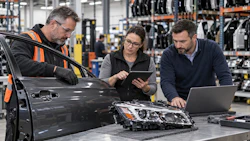
The Automotive Recyclers of Canada is calling for an evidence-based review of General Motors' restrictions on recycled OEM components, arguing that inspection, testing, and calibration standards could enable the safe reuse of undamaged genuine parts while maintaining vehicle safety and warranty protections.
- GM's August 19 position statement prohibits salvage, recycled, used, and non-genuine aftermarket parts on Chevrolet, Buick, GMC, and Cadillac vehicles in the U.S.
- The Automotive Recyclers of Canada argues that recycled OEM parts are genuine original components, not aftermarket copies, and should be distinguished from inferior alternatives.
- A separate July 20 GM statement specifically prohibits recycled components for advanced driver assistance systems, including cameras, radar units, and sensors.
- Canadian owner's manuals for 2026 Buick models still list recycled original GM parts as acceptable for collision repairs, creating inconsistency with U.S. policy.
- ARC proposes that safety concerns can be addressed through inspection, testing, traceability, and calibration standards rather than blanket prohibitions on undamaged recycled components.
The Automotive Recyclers of Canada executive director Wally Dingman has called for an evidence-based Canadian review of General Motors’ restrictions on recycled OEM components.
Dingman said ARC has maintained a collaborative relationship with GM and other vehicle manufacturers through the Canadian Vehicle Manufacturers’ Association. GM has not promoted the same position as strongly in Canada, he said.
“That does not necessarily mean the underlying technical position is different here,” Dingman said. “However, ARC’s preference is to continue working collaboratively to understand the concerns and determine whether inspection, testing, traceability and calibration standards can provide a responsible path for the reuse of undamaged recycled OEM components.”
GM’s current U.S. position statement, dated August 19, prohibits salvage, recycled, used and non-genuine aftermarket parts on Chevrolet, Buick, GMC and Cadillac vehicles.
The statement defines recycled parts as components removed from vehicles that were previously damaged, flooded, burned, scrapped or otherwise retired. It directs repairers, insurers and consumers to use new genuine GM parts for collision, structural and system-dependent repairs.
GM identifies possible previous damage, corrosion, changes to material properties, safety-system performance and gaps in recall traceability among the reasons for the restriction. Damage or failure caused by a non-approved part is excluded from GM warranty and service-plan coverage.
A separate position statement dated July 20 applies specifically to advanced driver assistance systems. It prohibits recycled, reconditioned, remanufactured and aftermarket cameras, radar units, sensors, control modules, wiring, brackets and mounting hardware.
The U.S. wording differs from information still provided to Canadian customers.
The Canadian owner’s manual for the 2026 Buick Envista describes a recycled original GM part as a possible choice for maintaining the vehicle’s designed appearance and safety performance. The manual also tells customers that they may specify either new genuine GM parts or recycled original GM parts for collision repairs. It notes that recycled parts are not covered by the GM vehicle warranty.
The Automotive Recyclers Association, a U.S.-based trade group, challenged GM’s position on August 14.
ARA executive director Vince Edivan questioned why an ADAS component already installed on a collision-damaged vehicle may remain in service after inspection, diagnostics and calibration, while an undamaged component recovered from another vehicle is rejected.
“We support repair decisions based on safety, testing and objective evidence, not blanket assumptions about the source of a part,” Edivan said.
The Automotive Recyclers of Indiana raised a similar objection on August 7. The association said recycled OEM parts are original components made for the vehicle rather than aftermarket copies.
Dingman said the Canadian discussion should focus on whether technical standards can address the concerns identified by GM without excluding undamaged OEM components from the repair market.
“Our objective is an evidence-based approach that protects safety while preserving access to affordable, genuine OEM parts,” he said.