Africa's automotive sector faces a critical challenge with 85% of vehicles in Nigeria being used imports and virtually no formal recycling systems, but this gap represents significant business opportunities in collection, dismantling, depollution, parts reuse, and remanufacturing across the continent.
- About 85% of vehicles imported into Nigeria are used, with no formal auto recycling industry operating in the entire 15-member ECOWAS region.
- South Africa's insurers write off approximately 517,000 vehicles annually, but only about 15,000 are formally recycled through official channels.
- Vehicle theft and illegal parts sales cost South Africa an estimated 3.1 billion rand annually due to weak traceability and VIN cloning.
- Key business opportunities exist in collection, dismantling, depollution, shredding, parts reuse, and remanufacturing of engines, transmissions, and electrical components.
- Governments must establish functioning registration, deregistration, and treatment systems before major private investment in formal recycling infrastructure will follow.
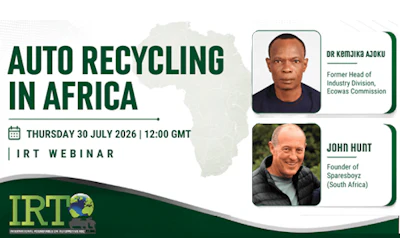
Used vehicles play an important role in Africa’s automotive sectors, but formal recycling systems are all but nonexistent, speakers said during July 30 International Roundtable event.
The IRT is an international forum where auto recycling associations and industry representatives compare policy, regulation and business practices. Steve Fletcher, of the Automotive Recyclers of Canada, moderated the session with Haydn Davies of Auto Recycling World.
Dr. Kemjika Ajoku, a Nigerian industrial-policy specialist and former ECOWAS industry official, said about 85% of vehicles imported into Nigeria are used. He said Nigeria has no formal auto recycling industry and was not aware of one operating anywhere in the 15-member ECOWAS region.
“There’s no single formal recycling industry in Nigeria, none,” Ajoku said.
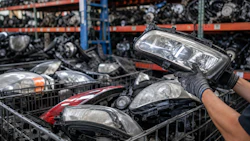
He said end-of-life vehicles commonly accumulate at repair shops, police stations and scrapyards or are abandoned along roads. Most dismantling is manual and informal.
Nigeria also lacks widespread depollution, shredding and material-separation capacity.
“In fact, actually, the depollution is not being practised,” Ajoku said. “We do not do bulk recycling, neither do we do material separation through shredding.”
Ajoku said the country has ELV rules, including frameworks introduced in 2013 and 2024, but weak enforcement, poor vehicle records and the absence of authorized scrapping facilities limit their effect.
He also identified business opportunities in collection, dismantling, depollution, shredding, parts reuse and remanufacturing. Engines, transmissions, starters, alternators, turbochargers and steering components were among the parts he identified as candidates for reuse or remanufacture.
John Hunt, founder of South African used-parts recycler Sparesboyz, said South Africa has a larger existing dismantling industry but still lacks an effective system for moving written-off vehicles through formal channels.
Hunt estimated insurers write off about 517,000 vehicles annually, while about 15,000 are formally recycled. He also estimated that only 30% to 35% of South Africa’s roughly 12 million vehicles are insured. Those figures were presented by Hunt and were not independently verified during the webinar.
He linked weak vehicle traceability to theft, illegal parts sales, cross-border movement and VIN cloning.
“Cars are getting stolen for parts on a constant basis,” Hunt said. “Cars are also getting stolen to go cross-border.”
Hunt estimated 3,000 to 5,000 cloned vehicles are created every six months and put the annual value of stolen vehicles retained in South Africa for cloning at about 3.1 billion rand.
Ajoku argued governments need functioning registration, deregistration and treatment systems before major investment will follow.
Hunt took the opposite view.
“I want to get out there and I want to start an official end-of-life vehicle recycling organization,” he said.
Fletcher said the underlying problems are familiar to Canadian recyclers, including informal operators, cloning and weak control over end-of-life vehicles.
“You will see the same language, the same challenges,” he said.