ADAS calibrations often pass with green diagnostic codes despite vehicles leaving bodyshops unsafe because technicians treat the process as a software procedure rather than a physical validation, with most failures caused by improper sensor mounting angles, unstraightened vehicle structure, and environmental lighting conditions rather than tool malfunctions.
- Root cause: Most ADAS calibration failures stem from physical setup issues like sensor angles, floor levels, and lighting—not software or tool problems.
- Structural alignment critical: If vehicle structure isn't straightened properly, ADAS systems amplify small errors, causing sensors to point in wrong directions despite passing alignment specs.
- Common workarounds create risk: Technicians sometimes raise target stands to compensate for mounting errors instead of fixing the actual mount, masking underlying problems.
- Target quality matters: Print-at-home calibration targets with pigment or gloss deviations can degrade calibrations even when diagnostics show success.
- Environmental factors: Lighting changes throughout the day affect camera system interpretation, requiring consistent shop conditions or lighting sensors to ensure reliable calibrations.
AUTEL AND I -CAR SAY PHYSICAL SETUP ISSUES DRIVE MOST FAILURES
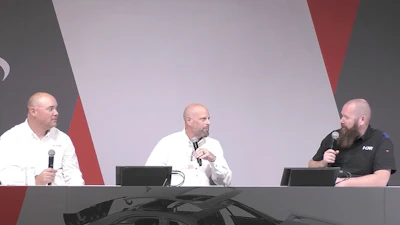
A car can leave a bodyshop with no fault codes, drive straight off the lot and still be unsafe. That was the warning delivered during The Real ADAS Blindspot – Why ADAS Calibrations Fail, a session at the SEMA Show moderated by I-CAR’s Scott VanHulle on November 4, 2025.
VanHulle interviewed Autel’s Stewart Peregrine and Eric Sponhaltz about reasons vehicle calibration failures. The pair’s message to the collision industry was straightforward: scanning technology has evolved faster than the repair process supporting it and calibration failures are being treated as software problems when they are overwhelmingly physical ones.
Autel’s internal data shows its equipment supports an average of 250,000 ADAS calibrations each month. Around 2,400 of those cases require technical assistance. Peregrine said the calls are rarely caused by tool failure. “Most of the time, the system is communicating properly. The issue is the set-up—sensor angles, floor levels, lighting. Technicians are passing calibration without correcting those conditions first,” he said.
VanHulle argued that modern safety systems are exposing long-standing weaknesses in the way shops judge repair quality. Sensors do not simply need to be present; their mounting must be at precise angles verified through measurement.
“If the vehicle structure isn’t straightened properly, nothing else will be right,” he said. “And ADAS amplifies those small errors. You can have ‘green’ alignment specs that are still pointing the system in the wrong direction.”
Instead of addressing root causes, technicians are sometimes unknowingly working around them. Peregrine pointed to radar systems being passed through calibration by raising the target stand to compensate for mounting errors. “Any time you have to raise the stand to get the calibration to go through, that’s a red flag,” he said. “You should be taking that bumper off and fixing the mount.”
Many bodyshops make use of print-at-home targets to reduce the cost of calibration procedures. This practice also received criticism from the duo. Peregrine stated that minor deviations in pigment and gloss can degrade a calibration even when the diagnostic report shows success.
“There’s a significant risk when you print your own targets,” he said. “The black has to meet exact specifications. If it’s off, the repair won’t be reliable.”
The panel emphasized that environmental conditions are just as crucial. Lighting changes throughout the day affect how camera systems interpret digital targets. Sponhaltz explained that Autel has begun integrating lighting sensors to compensate for inconsistent shop environments.
“Shops don’t have perfect lighting at nine in the morning and they don’t have perfect lighting at three in the afternoon,” he said. “Our sensors adjust the brightness so calibration happens under consistent conditions.” According to the presenters, the solution to this problem lies in treating calibration as a physical validation process guided by measuring technology — not as a button-driven software procedure.
Sponhaltz noted that newer optical systems measure wheel alignment, floor pitch and sensor angles before allowing technicians to proceed. “Our cameras capture the vehicle in 360 degrees and measure the frame angle to meet OEM specs,” he said. “The technician can’t move forward until the numbers are correct.” VanHulle said the industry’s focus on reimbursement debates misses the point.
“From a collision repair standpoint, the question shouldn’t be who pays for the procedure,” he said. “The question is whether the system is out of specification.”
collisionrepairmag.com/15773719