
Transdev Voyago, a Toronto-based transit operator, uses AI-powered cameras to detect drowsy drivers and dangerous driving behaviors in real time, resulting in a 10 percent reduction in preventable collisions over three years. The system provides instant audible warnings to drivers and alerts supervisors when hazardous behaviors like drowsiness, distraction, or harsh braking are detected.
- 10% collision reduction: Transdev Voyago achieved a measurable 10 percent drop in preventable collisions since implementing the AI system three years ago.
- Dual-camera monitoring: Forward-facing cameras detect external hazards like speeding and harsh braking, while driver-facing cameras identify drowsiness, distraction, and inattention.
- Real-time alerts: The system sends immediate audible warnings to drivers and notifications to supervisors when dangerous behaviors are detected.
- Long-shift application: Non-emergency transport drivers work 12-hour shifts, making fatigue detection critical for patient safety and accident prevention.
- Emerging Canadian trend: AI driver monitoring is expanding in Canada through systems by Bell Canada, Brigade, and Onlia, with rewards programs incentivizing safe driving.
Toronto, Ontario -- Transdev Voyago, a global public transport operator, is using an artificial intelligence system created by Genuine Tracking Solutions to identify dangerous driving behaviours, threats and concerns through live cameras and telematics.
According to the Ontario-based transportation company, since introducing the technology three years ago, there has been a 10 percent reduction in preventable collisions.
The AI-powered cameras used in Transdev Voyago’s transit vehicles and non-emergency transportation vehicles monitor the road for external dangers, such as following too closely, speeding, harsh braking, turning and acceleration.
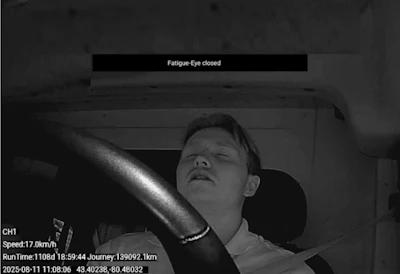
Hazardous driving behaviours are also monitored by cameras facing the driver, which captures drowsiness, distraction, lack of attention and looking away repeatedly. Notifications will be sent to the driver and to the driver’s superior.
The camera’s audible warning is loud, and it will say to the driver, “Warning, warning. Drowsiness alert, drowsiness alert” before taking and sending a picture to Chris Stoodley, the director of safety at Transdev Voyago. The company’s non-emergency transportation vehicles transport stable patients in Kitchener-Waterloo, but also do facility transfers to and from Ottawa and Kitchener, resulting in company drivers being on the road for 12-hour shifts.
Transdev Voyago hopes to eventually put the technology in the hundreds of school buses it deploys throughout the Waterloo region.
AI software in Canada monitoring driver behaviour is not new, but has yet to be widely implemented. Existing technology includes AI-powered dashcams in commercial vehicle fleets by Bell Canada and Brigade’s AI driver safety camera. In 2019, Canadian insurance provider Onlia developed the free mobile app Onlia Sense to reward safe driving. It uses telematics to track acceleration, braking, cornering, speed and distracted driving, scoring each trip out of 100.
High-scoring drivers can earn rewards including up to $100 in Starbucks gift cards while insurance customers can earn up to $500 in cash back annually.
The app also provides customized driving coaching.
All drivers must drive 500 kilometres and complete 30 trips before they qualify for rewards and make at least 10 trips and drive 200 kilometres a month to remain qualified.