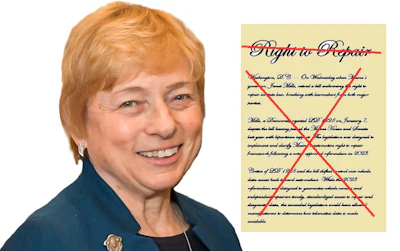
Washington, D.C. -- On January 7, Maine’s governor, Janet Mills, vetoed a bill enshrining the right to repair in state law, breaking with lawmakers from both major parties.
Mills, a Democrat, rejected LD 1228 on January 7, despite the bill having passed the Maine House and Senate last year with bipartisan support. The legislation was designed to implement and clarify Maine’s automotive right to repair framework following a voter-approved referendum in 2023.
Critics of LD 1228 said the bill shifted control over vehicle data access back toward automakers. While the 2023 referendum was designed to guarantee vehicle owners and independent repairers timely, standardized access to repair and diagnostic data, the amended legislation would have allowed manufacturers to determine how telematics data is made available.
Opponents, including Mills, have argued the approach risks delaying or limiting access in practice, putting independent shops at a competitive disadvantage and reducing consumer choice. Mills also noted the provision was not part of the unanimous recommendations of a post-referendum working group and was added at the urging of automakers, raising concerns that the changes weakened rather than implemented what voters had approved.
That referendum made Maine the first U.S. state to mandate that automakers provide vehicle owners and independent repairers access to repair and diagnostic data generated by modern vehicles, including data transmitted wirelessly through onboard telematics systems. The law came into force in January 2025, but enforcement and implementation have remained contentious.
Under Maine’s legislative rules, bills passed late in a session automatically become law unless the governor vetoes them within three days of the next session opening. The 2026 session began this week, triggering that deadline.
In her veto message, Mills said the bill departed from the intent of the referendum and would harm independent repair shops. She pointed to what she described as a “controversial provision” that would allow automakers to determine how vehicle telematics data would be made available to independent repairers.
“That access is essential to diagnosing and repairing modern automobiles,” Mills wrote. “However, without timely access to vehicle data, independent auto shops are left at a significant competitive disadvantage, and consumers would have fewer choices for automotive service and repair.”
Mills said the provision was not part of the unanimous recommendations of a working group established to study the law’s implementation and was added at the urging of automobile manufacturers. She also said she heard from hundreds of independent repair shop owners asking her to veto the bill.
Groups representing independent repairers welcomed the decision. The Auto Care Association, a U.S. aftermarket industry group, said the veto upheld the will of voters and preserved the core intent of the right to repair law.
Automakers disagreed. The Alliance for Automotive Innovation, which represents major vehicle manufacturers, has argued that Maine’s law raises unresolved privacy and cybersecurity issues. The group has also said the law requires the state to build a secure system for handling vehicle data that does not yet exist, making compliance impractical.
The veto leaves Maine’s right to repair law in force without the amendments proposed in LD 1228. Further legislative action and legal challenges are expected as regulators, automakers and independent repairers continue to dispute how vehicle data should be shared in an increasingly connected automotive market.