“I THINK IT’S GOING TO BE THE FRANCHISES... THAT ARE GOING TO DO WELL. THEY’LL MAKE DEALS WITH THE CHINESE OEMS TO FIX ALL THEIR CARS.” — RICH RODRIGUES
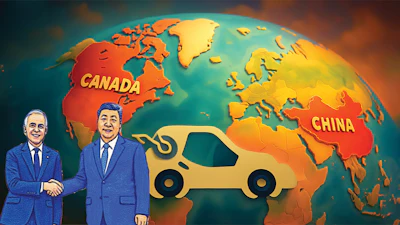
Collision repair industry members across Canada are responding to news that the federal government is eliminating the 100% tariff on Chinese-manufactured electric vehicles.
“It is what it is, you know?” Sylvain Audy of Audy Auto Body in Victoria, B.C. told Collision Repair, adding that the policy change is unlikely to materially affect his operation. “EVs will be cheaper, but I don’t think I see this having too big an impact on my business.”
Under the trade agreement announced this week, Canada will allow up to 49,000 Chinesemade EVs a year to enter the country at the standard 6.1 percent tariff rate, replacing the 100 percent duty imposed last year. Federal officials say the cap represents less than three percent of annual new-vehicle sales and amounts to a return to pre-friction trade levels.
Prime Minister Mark Carney has framed the decision as a pragmatic reset rather than a shift in industrial policy. Speaking to reporters during a press scrum, Carney said the agreement represents “a return to levels prior to recent trade frictions, but under an agreement that promises much more for Canadians.”
In a formal statement, he added that Canada is “forging a new strategic partnership that builds on the best of our past, reflects the world as it is today, and benefits the people of both our nations,” arguing Canada must engage globally “as the world is, not as we wish it to be.”
Ottawa says half of these vehicles will be sold for less than $35,000, a move that is already drawing concern from several auto industry trade groups.
The Automotive Parts Manufacturers’ Association has warned that opening the door to Chinese EVs risks exposing Canada’s auto sector to heavily subsidized competition. APMA president Flavio Volpe has said there is “no fair trade with China’s auto sector” without strong safeguards and has cautioned governments against policy moves that could undermine billions of dollars in recent investment in Canadian EV and battery supply chains.
The Canadian Vehicle Manufacturers’ Association has echoed those concerns, repeatedly stressing the importance of maintaining alignment with the United States and protecting domestic manufacturing. The association has warned that easing barriers on Chinese EVs could threaten Canadian jobs and complicate North American trade relationships at a time when the auto industry is already navigating supplychain and tariff volatility.
Chinese automakers already sell some of the lowest-priced EVs in Europe, offering a glimpse of what could arrive in Canada. Entry-level models such as the Leapmotor T03 sell for about $26,000, small Chinese city EVs have appeared at roughly $18,700 and compact hatchbacks like the BYD Dolphin Surf land in the $33,000 to $36,000 range. Those prices undercut many EVs currently sold in Canada, where sticker prices often start above $45,000 and quickly rise into the $60,000 to $80,000 range.
Some independent shop owners expressed concerns that any upsides of the deal will be for large, networked repair organizations. Rich Rodrigues, owner of Dupont Auto Collision Ltd. in Toronto, said scale and OEM relationships will matter. “I think it’s going to be the franchises... that are going to do well,” Rodrigues said. “They’ll make deals with the Chinese OEMs to fix all their cars.” In Eastern Canada, several shop owners expressed skepticism that lower prices alone will drive adoption. Erin Cole of Brian Mackie Auto Repair LTD — which does not repair EVs — questioned whether affordability will overcome practical barriers. “I can’t see our clientele going out and buying EVs just because they’re going to be cheaper,” Cole said. “We barely have the infrastructure for EVs out right now. I don’t see that changing quickly.”