TRAINING THAT SAVES LIVES: TERC CHALLENGE RETURNS TO STANDARD AUTO WRECKERS
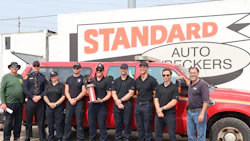
A familiar roar returned to Standard Auto Wreckers—not of engines, but of hydraulic rescue tools, saws and the dedicated teamwork of first responders. On June 5 and 6, the auto recycling yard once again transformed into a high-intensity training ground, hosting the 2025 Transportation Emergency Rescue Committee (TERC) Regional Vehicle Rescue Challenge.
Organized by TERC Canada and hosted in collaboration with the Markham Fire Department and the Markham Fire Extrication Team, the two-day event brought together fire departments and emergency response crews from across the region. These elite teams tested their mettle in realistic extrication scenarios, proving that effective vehicle rescue is as much about precision and planning as it is about bravery.
The Challenge featured two competition pits—limited and unlimited—where teams were given just 20 minutes to safely extricate a live “patient” from a mock vehicle collision. Judged on command structure, hazard control, disentanglement technique and rescuer and patient safety, the competition put participants through the kind of pressurecooker conditions that mirror the chaos of a real accident scene.
In the limited pit, teams could use only hand and pneumatic tools. In the unlimited pit, all tools—including hydraulic cutters, spreaders and stabilizers—were allowed. The Burlington Fire Department claimed top honours, winning both categories and securing the overall title. They will go on to represent Canada on the world stage next year. Standard Auto Wreckers, was proud to once again open its gates. For David Gold, owner of the facility, the event is more than just a competition—it’s a mission. “We’re all proud to be a part of it,” said Gold. “Everyone feels good to be helping first responders.”
Beyond supplying vehicles and space, Gold and his team assist with logistics, equipment setup and even support crews travelling internationally.
“One person can make a difference, and everyone should try,” said Brad Sterling of the Markham Fire Department, quoting John F. Kennedy in a heartfelt tribute. “David Gold has had a massive impact on the fire service—not just here in Markham, but across departments. He provides vehicles, facilities, staff support and even attends our events in the U.S. His unwavering commitment has made him family to our team.”
Events like the TERC Regional Challenge shine a spotlight not only on emergency responders but also on the critical partnerships that make this life-saving training possible. From local businesses donating vehicles, to auto recyclers offering space, to municipal fire departments dedicating time and resources— every stakeholder has a role to play.
“We are sincerely grateful for our Chiefs and the time they spend with us,” Sterling continued. “They’ve helped build a strong culture. This isn’t just about auto extrication— it’s about growing as a team and serving our community better.”
As TERC Canada and Standard Auto Wreckers look to the future, the goal remains clear: better training, safer roads and stronger communities. With public support and private leadership like that of David Gold, the next generation of rescue heroes will be even better equipped to face the challenges ahead.

CLEANER PASTURES: LKQ RELEASES GROUNDBREAKING SUSTAINABILITY REPORT
One of the world’s largest auto parts sellers has released a major report on the environmental impact of its activities.
In its 2024 sustainability report, LKQ showcased the significant strides in environmental performance, circular economy leadership and community engagement it made throughout the year in which the company processed 735,000 vehicles and sold nearly 12 million recycled parts.
The company reduced its Scope 1 and 2 greenhouse gas emissions by 16 percent relative to revenue, compared to a 2022 baseline. This was accomplished through the increased use of renewable energy, fleet fuel initiatives, energy efficiency upgrades and network optimization efforts. For collision repair facilities using LKQ parts, the company’s carbon reduction also alleviate Scope 3 emissions.
“We’re focused on continuous improvement in reducing greenhouse gas emissions across our operations,” said Justin L. Jude, LKQ’s chief executive officer. “This commitment is linked to our dedication to frugality and waste reduction, going beyond just regulatory compliance. Our goal is to continue sharing best practices across our global operations, particularly in areas like electricity consumption reduction and fleet efficiency initiatives.”
Looking ahead, LKQ aims to reduce global Scope 1 and 2 emissions by 30 percent by 2030 relative to revenue and achieve netzero emissions across its operations by 2050.
During the year, LKQ donated more than US$4 million through to support health, education, veteran services and environmental stewardship. Employees participated in over 200 local initiatives, demonstrating the company’s commitment to social responsibility.

AUTO PARTS LOGISTICS MARKET EXPANDING
Canada’s automotive spare parts logistics market is poised for strong growth, driven by rising vehicle maintenance needs and rapid technological change.
According to a report by Custom Market Insights released June 25, 2025, the global market is projected to expand from US$312.61 billion in 2025 to US$663.27 billion by 2034, at a compound annual growth rate of 8.67 percent
In the North American context the U.S. remains a dominant force with a mature automotive manufacturing base and tight supplier networks. Key seaports offer specialized vehicle‑handling facilities and are linked to well‑developed inland trucking and rail systems, enabling efficient transport of spare parts . The continent also leads in adopting smart logistics technologies like cloud platforms, autonomous vehicles and advanced tracking systems to improve speed and reliability.
The report’s SWOT analysis highlights several strengths for the industry, including its established warehousing and transport infrastructure, an increasing number of older vehicles driving demand and the growing use of AI‑enabled inventory management. It also identifies weaknesses such as the complexity of coordinating large distributor and supplier networks, challenges in maintaining optimal inventory levels without incurring high costs and the risk errors in real‑time tracking systems may disrupt operations.
Opportunities include growth in emerging markets, expansion of online parts sales channels and integration of blockchain, IoT and AI to improve logistics efficiency. Threats include trade‑related disruptions affecting parts cost and availability, and intensifying competition from local suppliers offering lower‑cost alternatives.
Supplementary data from Research and Markets shows the broader automotive logistics market will grow from US$261.7 billion in 2025 to US$553 billion by 2034 at an 8.7 percent CAGR.
Analysts also report that global spare‑parts logistics reached US$49.2 billion in 2024 and is expected to grow at 3.3 percent annually through 2033, while reverse logistics in Canada alone generated US$15 billion in 2024 and is forecast to grow at 15.1 percent a year.