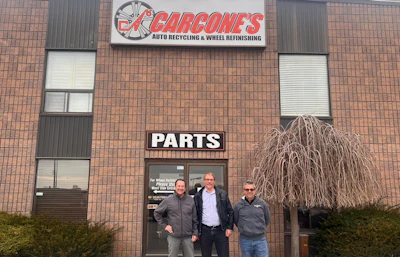
More than 100 automotive aftermarket figures visited Carcone’s Auto Recycling in Aurora, Ontario -- a business with a longstanding reputation as an industry leader when it comes to innovation.
About 100 people -- all delegates at the 2026 OARA Convention and Trade Show, attended the kick-off event, where owner Michael Carcone led guests through each stage of the recycling process. The walkthrough traced a part’s path from the vehicle compound through dismantling, into inventory storage and ultimately packaging for distribution, offering a clear view of how recycled components are processed and prepared for market.
The tour covered the full operation, from yard layout to dismantling bays and packaging systems, Carcone said, giving attendees a comprehensive look at how parts move through the facility.
Spanning roughly four hectares, or 10 acres, the facility employed about 50 staff and continued to evolve alongside industry demands. It had been featured during the 2023 OARA Convention and Trade Show, but had since expanded its capabilities, including the addition of three new wheel refinishing machines.
For attendees, the visit served as both a bench-marking exercise and a reset on expectations. “The organization and cleanliness stood out right away,” said Luke Gammon, a delegate representing Car-Part.com. “It’s a well-run operation, and seeing the processes firsthand was valuable.”
The facility’s specialized operations also drew attention. “The wheel refinishing side was impressive,” Gammon added. “There’s a lot of equipment and detail in that process.”
Max Winkler, with J&B Auto Recyclers, pointed to both efficiency and scale.
“It’s an extremely clean, organized shop,” he said. “The inventory depth and dismantling operation are impressive, and it was useful to see how their procedures work in practice.”
The ability to observe another recycler’s workflow firsthand remained a core draw of the tour, particularly in an industry with no single standardized approach.
“Recyclers learn best by seeing it,” said Steve Fletcher. “When they can walk through another operation and see how parts are handled and stored, that’s where the value is.”
According to Fletcher, the tour also served an outward-facing purpose, exposing partners and stakeholders to a more accurate picture of the sector.
“A lot of people still expect a traditional scrapyard,” Fletcher said. “Then they walk in and see a modern, high-tech operation. It changes how they view the industry.”