
Canada's EV market is experiencing rapid transformation as sales decline 35% due to eliminated tax incentives, while repair costs remain significantly higher at $6,923-$7,241 per claim, and vehicle depreciation accelerates—creating challenges for insurers, repairers, and consumers alike.
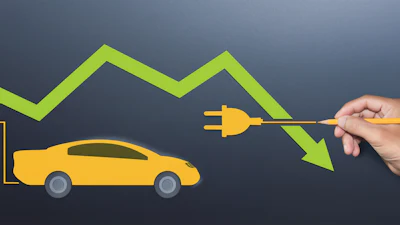
- EV sales in Canada dropped 35 percent year-over-year in June 2025, with Tesla down 67 percent in the first half of 2025.
- Average repair costs for battery-electric vehicles range from $6,923 to $7,241, driven by complex battery systems and OEM parts requirements.
- Total-loss frequency for BEVs rose from 5.9 percent in 2023 to 8.7 percent in 2025, matching ICE and hybrid vehicles.
- New EVs depreciate 15-20 percent in year one and 50-60 percent over five years, accelerated by manufacturer price cuts.
- Federal and provincial EV rebate rollbacks—particularly in Quebec and British Columbia—are the primary drivers of market decline and price sensitivity.
SALES SLIP, INCENTIVES DIM AND RISING WRITEOFFS RESET THE MARKET
Repair costs for electric vehicles (EVs) in Canada remain significantly higher than those for internal combustion engine (ICE) vehicles. According to collision-estimating leader Mitchell International, average repairable battery-electric vehicle (BEV) claims in recent reports range from $6,923 to $7,241. The added cost is driven by complex high-voltage battery management, a heavier reliance on original-equipment manufacturer (OEM) parts, and the need for frequent ADAS sensor recalibrations.
But repair expense is only one piece of a much larger puzzle. Slowing EV sales, paused or eliminated tax incentives, accelerated depreciation and rising total-loss frequency are reshaping the Canadian EV market at a rapid pace.
EV SALES DECLINE AND TESLA’S ROLE
Statistics Canada reported a 35 per cent year-over-year decline in EV sales for June 2025. Tesla, once the dominant player, has been hit even harder: sales are down 67 per cent in the first half of 2025 compared with last year, with just 9,000 units sold nationwide.
Two key drivers are behind the slump: the rollback of federal EV rebates and provincial programs in British Columbia and Quebec. Quebec’s temporary suspension of its zero-emission vehicle (ZEV) subsidy in the first quarter of 2025 led to a 65 per cent sales drop in the province. Once reinstated, sales began to recover, rising from 14.8 per cent of new vehicles in the first quarter to 16.4 per cent in April. The message is clear—EV sales remain highly price-sensitive. In British Columbia, the CleanBC Go Electric personal-vehicle rebate program was paused in May 2025, with a program review expected this fall. In the meantime, expect discounted lease deals and manufacturer-backed rebates as automakers attempt to fill the gap.
TESLA’S PRICE CUTS AND DEPRECIATION
Tesla has attempted to stem the decline by aggressively cutting prices, most notably trimming the Model Y by $20,000, and importing vehicles from Germany to sidestep U.S. tariffs. These moves have done little to boost sales but have severely affected existing owners, who face steep and unexpected depreciation.
EVs already depreciate faster than ICE vehicles, but Tesla’s frequent price cuts have made its curve among the steepest in the industry. Compounding the problem, CEO Elon Musk’s controversial behaviour—which has drawn criticism in Canada— has further eroded consumer confidence and resale values north of the border.
REPAIR COSTS, TOTAL LOSSES AND MARKET IMPLICATIONS
What do these sales declines and price reductions mean for the repair industry? Quite a lot.
Tesla’s unique design, where the battery is a structural component, makes collision damage far more likely to result in a total loss. Add slow parts availability, extended repair cycle times and high rental costs, and insurers are often left with little choice but to write off damaged Teslas.
As Tesla’s dominance in the EV car parc (in-service fleet) declines, repairability should improve. Traditional automakers often design their battery systems to be less structurally vulnerable, meaning fewer total losses when collisions occur.
Mitchell data show Canada’s BEV total-loss frequency rising from 5.9 per cent in 2023 to 8.7 per cent in 2025, now on par with ICE and hybrid vehicles. Market conditions—removal of tax incentives, slowing sales and accelerating depreciation—are likely to push those numbers even higher.
Currently, new EVs in Canada lose an estimated 15 to 20 per cent of value in the first year and up to 50 to 60 per cent over five years, depending on the model and conditions.
THE PATH FORWARD
Taken together—slower new-vehicle sales, higher repair costs, faster depreciation and rising total-loss frequency—the Canadian EV market faces a complex future. EVs are not going away, but for adoption to remain sustainable, manufacturers must take a more active role in improving the collision-repair experience.
By focusing on parts availability, battery design and total-loss prevention, automakers can help insurers, repairers and consumers navigate this shifting landscape and ensure EV ownership remains viable for Canadian drivers.