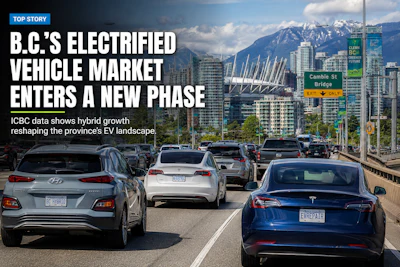
British Columbia’s vehicle market is entering a new phase.
Fresh data released by ICBC shows hybrid vehicle registrations are now outpacing battery electric vehicles in the province, while overall crash counts, injury crashes and auto crime continue trending downward. The findings offer another glimpse into how consumer behaviour, vehicle technology and repair complexity are evolving at the same time.
The insurer’s updated 2025 data release also highlights a growing divide between electrification goals and real-world consumer adoption patterns.
According to ICBC, hybrid registrations have steadily climbed and now exceed annual EV registrations in B.C. each year. While electric vehicle adoption accelerated rapidly over the past several years, ICBC says growth has now begun to slow. Gas-powered vehicle registrations also remain below pre-2020 levels.
For the collision repair industry, the trend matters.
Hybrids often bring many of the same repair and safety considerations as EVs, including high-voltage systems, advanced electronics and increased calibration requirements. Yet they typically avoid some of the range anxiety and charging concerns that continue influencing consumer purchasing decisions.
That creates a changing mix of vehicles entering repair facilities.
Bodyshops across Canada have spent the last several years preparing for a wave of full battery electric vehicles through investments in tooling, technician training, insulated equipment and OEM certification programs. But hybrid growth may now create a broader middle ground for repairers.
The shift could also affect claims severity.
Hybrids frequently carry complex electronic architecture and ADAS systems similar to EVs, but with the added presence of internal combustion components. Repair planning, scanning and parts sourcing can become more complicated when two propulsion systems exist within the same vehicle.
ICBC’s numbers also show overall crashes and injury crashes remain below pre-pandemic levels despite more vehicles being on B.C. roads. Injury crashes in 2025 were 21 percent below the 2016-2019 pre-pandemic average, while total crashes were three percent lower.
The insurer attributes part of the change to lasting shifts in driving patterns following the COVID-19 pandemic, along with the introduction of Enhanced Care in 2021.
For repair facilities, lower crash frequency does not necessarily mean lower repair complexity.
Across North America, repairers continue reporting rising severity levels tied to ADAS technology, OEM repair procedures, material changes and increased parts costs. A vehicle involved in a moderate collision today often requires far more diagnostic work than a similar repair did even five years ago.
ICBC’s data also revealed a significant drop in auto crime.
Vehicle break-ins have fallen 60 percent since 2016, while stolen vehicle incidents are down 46 percent over the same period. Vandalism claims have remained relatively stable.
The insurer noted Friday afternoons between 3 p.m. and 5 p.m. remain the riskiest driving period in the province.
Meanwhile, vulnerable road user trends continue to evolve.
Pedestrian crashes remain the highest among vulnerable road users, though still below pre-pandemic levels. Cyclist crashes have steadily increased and now slightly exceed pre-2020 counts. Motorcycle crashes remain relatively stable.
For EV and hybrid repair specialists, those patterns matter because urban driving environments increasingly shape collision frequency and repair types. Low-speed impacts involving sensors, cameras and radar-equipped bumpers continue driving higher repair costs, particularly in electrified vehicles.
The release also reinforces a broader issue facing the repair sector: electrification is not replacing traditional vehicle technology as quickly as many originally expected.
Instead, the market appears to be diversifying.
Repair facilities are now being asked to safely repair gas-powered vehicles, hybrids, plug-in hybrids and full battery electric vehicles simultaneously. That creates training, tooling and workflow challenges that many independent repairers are still trying to solve.
At the same time, insurers, OEMs and repairers continue debating repair standards, battery handling procedures and total-loss thresholds for electrified vehicles.
Those concerns are particularly important in British Columbia, where previous analysis involving ICBC salvage auctions found only a small percentage of rebuild-designated EVs ultimately returned to the road after inspection.
As EV adoption stabilizes and hybrid registrations rise, repairers may find themselves operating in a more complex transition period than originally anticipated.
Rather than moving directly from internal combustion to full electrification, the industry may instead be entering a long hybrid era where multiple propulsion technologies coexist inside the same repair environment.
ICBC says additional 2025 data on fatalities and police-reported crashes will be released later this year following reconciliation with the BC Coroners Service, RCMP and RoadSafetyBC. (icbc.com)