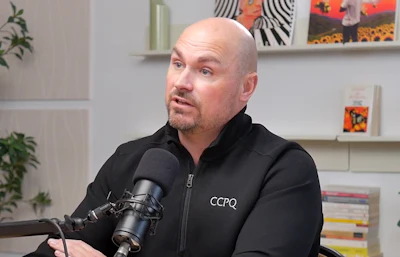
The president and executive director of the Corporation des carrossiers professionnels du Québec says 2026 will be a pivotal year for Quebec’s bodyshop sector.
In a recent podcast episode, CCPQ president and executive director Jonathan Pilon and communications and business relations advisor Kassy Vaudry discussed the association’s priorities following what they described as a difficult 2025.
Pilon said the organization had spent the past year focused on restoring stability and credibility after several years of organizational instability. “We brought stability back to the CCPQ,” he said. “Just being here today, in 2026, with a clear strategic plan, with partners who stayed with us and are still here, that’s already a success.”
He also mentioned that the association was now focused on growth. The CCPQ set a target of 300 members, including partners, by the end of 2026, a move Pilon said would strengthen both financial stability and the association’s ability to represent the sector.
“The reason an association exists is its members,” he said.
Vaudry said many of the challenges facing collision repair businesses had remained unchanged for decades. “When you look at the concerns bodyshop owners have today, they’re the same ones we had 30 years ago,” she said.
Pilon said responsibility for addressing those issues ultimately rested with shop owners.
“We can say it’s insurers, we can say it’s networks, we can say it’s suppliers,” he said. “But at the end of the day, the real people responsible for the situation are the bodyshop owners. It’s us.”
Both speakers said the CCPQ was not seeking to negotiate labour rates or intervene directly in disputes with insurers. Pilon said the association’s role was to support business development and collaboration. “Are we going to get involved in hourly rates? No,” he said. “Are we going to get involved in insurer relationships? No.”
The CCPQ also outlined plans to introduce closed performance groups for shop owners and senior staff, focused on estimating, productivity, profitability and management practices. Pilon said the goal was to allow participants to share information and discuss operational challenges in a confidential setting.
The discussion also addressed professionalism within the trade. Vaudry said bodyshop operators should view their conduct as reflective of the industry as a whole. “Beyond representing your own shop or your banner colours, you represent the entire industry,” she said.
Pilon cited the medical profession as an example of collective professionalism. “You never hear a doctor say another doctor did a terrible job,” he said. “Collision repair is an essential trade too.”
The association said it had expanded its institutional presence. For a second consecutive year, the CCPQ held seats on the boards of all six Comités Paritaires de l’Automobile, which are involved in workforce training and labour relations. In 2026, CCPQ representatives included Pilon in Montréal, Samuel Fortier in Estrie, Éric Hénault in Laurentides–Lanaudière, Vaudry in Mauricie, Ian Boissonneault in the Quebec City region and Martin Leclerc in Saguenay.
Pilon said representation on those bodies was important to ensuring the sector’s interests were considered. “If we’re not at those tables, there’s no one speaking for collision repair,” he said.
The episode concluded with a call for greater engagement from shop owners. “There’s work. There will be work,” Vaudry said. “But at some point, we have to stop complaining and start acting.”