The Tuesday Ticker for July 14, 2026 highlights three major automotive industry developments: Ford of Canada reached a tentative three-year labour agreement with Unifor covering 5,150 workers, Swedish safety supplier Autoliv signed a strategic partnership with Chinese EV maker XPENG to advance vehicle safety technology, and Chinese insurance tech company YSX Tech reported 16.8% revenue growth but saw shares fall 34.6% due to declining profits despite higher sales.
- Ford Labour Deal: Ford of Canada secured a tentative three-year agreement with Unifor covering 5,150 union members across multiple facilities including Oakville Assembly Complex and Windsor plants
- Autoliv Partnership: Swedish safety supplier Autoliv signed strategic cooperation agreement with Chinese EV company XPENG covering technology development, digitalization, supply chain coordination and sustainability
- YSX Tech Results: Chinese insurance technology company reported fiscal 2026 revenue of US$83.5 million (up 16.8%) but experienced lower gross profit and operating income, causing shares to plunge 34.6%
- Industry Relevance: YSX Tech's auto insurance aftermarket services represent 96.7% of revenue, processing over 6 million service calls annually and affecting how insurers manage vehicle claims and repair facilities
In this week’s Tuesday Ticker, an American OEM reaches a tentative agreement with a Canadian labour union, a Japanese OEM reaps the rewards of a safe design and a safety systems partnership yields dividends.
Ford's Labour
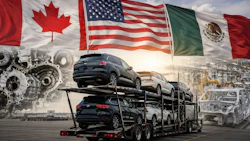
Ford of Canada has reached a tentative three-year labour agreement with Unifor.
The agreement covers 5,150 union members at Ford facilities in Canada, including workers at the Oakville Assembly Complex, the Windsor Annex and Essex Engine Plants, and parts distribution centres in Paris and Casselman, Ont., and Leduc, Alta. Details of the tentative deal were not released before ratification meetings.
“Securing this tentative agreement comes at a vital time for Canada’s auto workers and our domestic industry,” said Lana Payne, Unifor national president. “Every member of our bargaining committee came to the table resolved to reach a fair deal that protects good union jobs in the most challenging of economic times.”
Investors have not yet reacted to the news as Unifor members still need to ratify the agreement. During trading following the announcement, Ford shares were down 0.4% to US$13.94.
Autoliv safety systems
A Swedish automotive safety supplier has signed a strategic cooperation agreement with a Chinese electric vehicle and smart mobility company.
Autoliv Inc. signed the strategic cooperation framework agreement with XPENG. The agreement covers technology development, digitalization, supply chain coordination, sustainability and global business expansion. The work is meant to support safer mobility as vehicles become more electric, connected and global.
“XPENG is striving to explore the future of mobility, and Autoliv is proud to support that journey. As vehicles become smarter, safety must be integrated from the very beginning. This agreement reflects our shared commitment to innovation and safety, combining XPENG’s innovation in smart mobility with Autoliv’s global safety expertise to help make the next generation of mobility safer,” said Mikael Bratt, president and CEO of Autoliv.
Investors showed little reaction. As of the afternoon of July 13, Autoliv shares were trading at US$120.95, up 0.6% from the previous close.
YSX insurance tech
A Chinese insurance technology company has seen its shares fall sharply after investors looked past higher sales and focused on weaker profits.
YSX Tech Co. Ltd., which is listed on the Nasdaq, reported fiscal 2026 revenue of US$83.5 million, up 16.8% from the prior year. Most of that money came from services linked to auto insurance.
The company’s auto insurance aftermarket services brought in US$80.8 million, up 27.4%. That part of the business made up 96.7% of YSX’s total revenue.
YSX works with insurers on technology-based services, including auto insurance support, risk screening and other customized services. In practical terms, it helps insurers process and manage vehicle-related files before, during or after a claim.
The problem for investors was profit. Even though sales rose, YSX reported lower gross profit, higher operating costs and lower income from operations. In plain terms, the company brought in more money but kept less of it.
YSX processed more than 6.07 million service calls during the year, up 28.8%. Vehicle driving risk screening service volume rose 112.1% to about 5.6 million service calls.
The company is relevant to collision repair because insurers are using more technology to manage vehicle claims. That can affect how claims are screened, how files are routed and how much information repair facilities are asked to provide.
“Fiscal 2026 was a year of operational scaling and strategic realignment for YSX,” said Jie Xiao, CEO of YSX Tech. “We drove our top-line revenue to $83.5 million, representing a 16.8% year-over-year increase, fuelled primarily by a 28.8% increase in our service volumes.”
As of July 13 at 1:31 p.m. ET, YSX shares were down 34.6% to US$0.66.