Skills Canada National Competition 2025 in Regina from May 29-31 showcased Canada's top collision repair and auto painting talent, with winners like Ontario's Ethan Almeida and Alice Michaud earning opportunities to represent Canada at the 2026 WorldSkills competition in Shanghai.
- Event Details: Skills Canada National Competition 2025 took place May 29-31 at the REAL District in Regina, drawing top apprentices and students from every Canadian province
- Post-Secondary Auto Body Winners: Gold—Ethan Almeida (Ontario), Silver—Tyler Dooling (New Brunswick), Bronze—Renz Medida (Manitoba)
- Auto Painting Winners: Gold—Alice Michaud (New Brunswick, post-secondary) and Sabrina Armstrong (Ontario, secondary)
- Global Impact: Medalists qualify for the 2026 WorldSkills competition in Shanghai, where Canada competes against international vocational training programs
- Industry Significance: The competition serves as a critical recruitment tool and national showcase for addressing labour shortages in collision repair
TOMORROW’S REPAIRERS TAKE CENTRE STAGE
The roar of compressors, the hiss of spray guns, the hum of drills—late May 2025 in Regina belonged to the next generation of Canadian collision repair talent.
From May 29 to 31, the 2025 Skills Canada National Competition unfolded at the REAL District, drawing the top apprentices and students from every province. It was the culmination of months of provincial qualifiers, a proving ground where competitors would test their ability to repair panels, match colours and weld steel under the glare of judges’ eyes. Collision Repair Magazine followed the journey, from local heats to the national stage, to capture how the industry’s future took shape.
Skills Canada has always been more than a medal contest. The national event, staged annually since the 1990s, celebrates the trades and technologies that underpin Canada’s economy. For collision repair, the event has steadily grown from a niche competition to one of the most closely watched in the program. In 2024, the sector fielded its largest-ever presence, and 2025 was expected to build on that momentum. Each provincial contest acted as a qualifier, but also as a recruitment fair, sparking interest in high schools and colleges.
Manitoba’s winners in early 2025 included Renz Medida and Cole Cocquyt, who would later carry their skills to Regina. Across Canada, judges remarked on the enthusiasm. “Seeing the smiles on competitors’ faces shows the passion that the industry needs,” said judge Bill Speed.
By the time the doors opened in Regina, the stage was set. Contestants from Ontario, British Columbia, Alberta, New Brunswick and beyond converged in workshops packed with fume extractors, paint booths and welding bays.
The tasks were simple in description but daunting in execution: replace a damaged panel, weld new material seamlessly, blend a metallic finish to factory standards. Every slip of tape, every run in the clearcoat, every weld bead was measured against national benchmarks. Judges, drawn from independent shops, MSOs, and major suppliers, scrutinized each move.
Among them was Bill Speed, a long-time presence in the competition and Team Canada’s auto body expert for WorldSkills. He praised the standard in 2025, saying, “I believe we have some of the strongest competitors we’ve had in years.”
The tension peaked after two days of tasks when competitors were ushered out and the scoresheets collected. Spectators and educators watched as young tradespeople paced the hallways, replaying every weld, every polish. One mistake could separate gold from silver. For some, the stakes were higher still: victory could earn them the chance to represent Canada at the 2026 WorldSkills competition in Shanghai, where the country has often fought for recognition on the global stage.
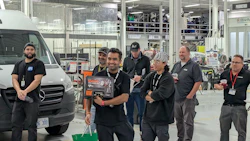
When the announcements came, the relief was visible. In the post-secondary auto body category, Ontario’s Ethan Almeida claimed gold.

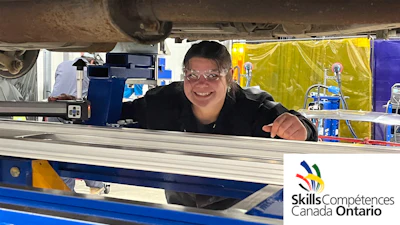
In auto painting, judges Cecile Bukmeier and others observed competitors mask, spray and polish with clinical precision. New Brunswick’s Alice Michaud emerged with gold in the post-secondary division, Alberta’s Anika Jones earned silver and British Columbia’s Monty Loetkeman bronze. The secondary medals went to Ontario’s Sabrina Armstrong with gold, B.C.’s Malakai Kameya with silver and Alberta’s Brooke Twaddle with bronze. Bukmeier explained the standards: “[Competitors must be] the highest ranking age-eligible competitor … We judge them on clearly outlined steps from the manufacturer … prepping, polishing and colour-matching.” For Jones, the silver medallist, the experience was unforgettable: “It feels unreal. I didn’t think I’d make it this far. It’s truly a once-in-a-lifetime opportunity!”
For the medalists, the podium was the culmination of years of training under mentors in colleges, shops and training centres. But even for those who missed the medals, the event left a mark. Employers, suppliers and trainers were present throughout, scouting potential apprentices and networking with educators. For the industry, the competition acted as a national showcase, underscoring both the talent pipeline and the importance of sustained investment in training.
Skills Canada’s reach extends beyond the competition floor. Its programming in Regina included Indigenous skills demonstrations, women-in-trades showcases and Try-a-Trade booths that let visitors pick up a spray gun or try panel beating for themselves. Those initiatives reflect a broader mission: making the trades visible and aspirational to the next generation. The collision repair community, often challenged by labour shortages, sees the event as a critical recruitment tool.
The significance of SCNC 2025 becomes clearer when placed in global context. Canada has long competed at WorldSkills, the international contest founded in 1950 to celebrate vocational training. Canadian auto body and painting competitors have historically faced tough rivals from Europe and Asia, where national training programs are heavily subsidized. The hope is that medalists like Almeida and Michaud can break through in Shanghai in 2026, where events are judged to standards equal to or exceeding those in industry. As Speed, who will coach Team Canada’s auto body representative, noted earlier in the year, the task is daunting but achievable.
Months after the cheers faded in Regina, the meaning of Skills Canada 2025 still resonates. The competition offered young technicians a national stage, validated their skills with medals, and set them on a path to international recognition. For educators and employers, it was a reminder that the future of the trade is not a distant prospect but a reality already forming. And for the industry at large, it was a chance to pause, celebrate and invest in the people who will ensure that vehicles on Canadian roads are safely and expertly repaired for decades to come.