
Plastic repair in collision shops represents a significant missed opportunity to convert replacement costs into profitable labor hours, but requires proper training, OEM compliance, fair compensation, and advanced repair technology to succeed.
- Repair-First Shift: Most collision centers default to replacing damaged plastics, but advanced welding technology and proper training now make repair economically and technically viable for bumper covers, headlights, and trim components.
- OEM Compliance Critical: Manufacturers' repair procedures and ADAS restrictions determine what can be safely repaired; shops must verify OEM guidelines before deciding to replace rather than repair.
- Economic Reality: Compensation and financial viability are the strongest barriers to plastic repair adoption; shops need proper pay for skilled labor to make repair worthwhile versus faster replacement options.
- Skill Development Opportunity: Plastic repair can be performed by less-skilled technicians with proper training, freeing experienced body technicians for complex metal work while building team capabilities.
- Industry Growth Potential: As vehicles incorporate more plastics and replacement parts become increasingly expensive and hard to source, industry demand for trained plastic repair specialists is expected to grow significantly.
Every damaged plastic part that goes into the discard pile represents a decision.
Sometimes replacement is absolutely the right one. OEM procedures may prohibit a repair, ADAS components can change what is permissible, or the location and severity of the damage may make replacement the only safe choice. But sometimes that discarded bumper cover, headlight or trim component represents something else: labour the bodyshop could have sold, profit it could have earned and a vehicle that might have left the shop sooner. That is why plastic repair deserves another look.
Materials used in vehicles have changed dramatically, as have repair technology and the cost and complexity of replacement components. Yet some of the thinking around plastic repair has been slower to follow.
 Kurt Lammon, President Polyvance.
“Most collision centres default to replace damaged plastics,” says Kurt Lammon, president of Polyvance, widely recognized as an industry leader and pioneer in automotive and industrial plastic repair. “Part of it is that we’re conditioned to think that plastic is disposable. It takes a shift in mindset to have a ‘repair-first’ mentality regardless of the material the part is made of.”
Opportunity extends well beyond the obvious bumper scuff or small crack. Mario Dimovski, president of Plasnomic and head of the Plastic Repair Alliance Council, points to bumper covers, headlights and exterior trim that have become increasingly common, complex and expensive. Plasnomic is building a global framework for automotive plastic repair, establishing standards, validation processes and industry alignment aimed at making plastic repairs safe, consistent and scalable. At the same time, equipment, materials and repair techniques have improved significantly.
“As an industry, we could potentially double the number of bumper covers and headlights currently being repaired,” says Dimovski.
 Daryll O’Keefe, Vice President, Business Development North America at Fix Network.
Daryll O’Keefe of Fix Network, a member of Plastic Repair Alliance Council, sees an industry that is already beyond the basic question of whether plastic can be repaired. “The debate is no longer ‘Should we repair plastic?’ but rather ‘When is it appropriate, safe, and financially viable to repair plastic?’”
Collision Repair’s Plastic Repair Survey points in much the same direction. Shops are already repairing plastic, while compensation, OEM requirements, training and confidence in the finished repair continue to influence how often repair is chosen over replacement.
Repair opportunities aren't limited to bumper covers either. Lammon points to headlight tabs, windshield washer bottles, inner fender liners and rocker panel mouldings among the plastic components that can present opportunities. “Repairing plastic offers a pathway to more labor hours, shorter cycle times, and better outcomes for all parties involved,” he says.
Start with the OEM
Increasing vehicle complexity makes that distinction more important than ever. Connor Alexy, application engineer with 3M’s Automotive Aftermarket Division, says repair technology has moved considerably from the fillers, glazes and systems once used.
“Today we have advanced adhesive technologies and plastic welding systems
that make repairing more consistent, more precise and quicker than before,” says Alexy. Improved technology can also allow technicians to tackle more complex areas, although ADAS has added new restrictions involving coating thickness and repair location.
Knowing what the manufacturer allows is therefore critical. Alexy sees a missed opportunity when shops treat restrictions around certain ADAS-equipped components as a blanket reason to replace plastic parts.
“Verify a part can or can’t be fixed by reading the OEM procedure, and if it can be fixed, take advantage of the opportunity instead of simply replacing that part,” he says.
OEM requirements are also one of the most frequently cited barriers in Collision Repair’s survey, reinforcing Alexy’s point that repair-versus-replace decisions increasingly begin with knowing exactly what the manufacturer permits. Lammon is equally direct. “Research OEM guidelines first to see if repair is prohibited,” he says. “If not, make sure the damage isn’t over a radar sensor mounted behind the part.” Skills and economics then become part of the decision. “If it makes economic sense to do the repair... and if your technicians have the skills to do the repair, then why not try a repair?”
A repair-first mentality isn't a repair-at-all costs mentality. Safe repair to pre-accident condition remains the objective.
Dollars have to work
Once a repair is determined to be technically appropriate, another reality enters the equation: somebody has to pay for it.
Dimovski believes commercial value may be one of plastic repair’s biggest missed opportunities. Repair can convert replacement-parts spending into productive labour hours, improve gross profit, reduce parts delays and give the bodyshop greater control over the repair cycle.
Frequent turnover among estimators and adjusters has also contributed to a knowledge gap, he says. Clearer repair criteria, consistent pricing models and industry-aligned best practices would help shops and insurers make better repair decisions.
“Shops must be properly compensated for the skill, documentation and value involved,” says Dimovski.
Compensation is the strongest theme in Collision Repair’s survey. Shops most often point to inadequate pay as a barrier and better pay as something that would encourage more repair, supporting what several of the experts told us about the need for the work to make sense commercially as well as technically.
O’Keefe puts the issue more simply: “Most resistance is economic rather than philosophical.” If replacement is faster, less risky or produces a similar or better financial result, the technical ability to repair a component isn't enough on its own to change behaviour.
Lammon provides a real-world example of how different the equation can look when repair works technically and financially. A second-generation BMW X5 arrived at a shop with a broken mounting tab on a polypropylene-blend fender. Replacement cost was $750 before paint, while the OEM finish on the damaged fender remained largely untouched.
“The shop got five hours plus $75 in materials to do the repair, which took the technician 15 minutes to do,” says Lammon. “The revenue was $325, cost was $110, yielding a 66% gross margin. And the cycle time was less than a day.”
Not every plastic repair will produce those numbers, nor should every decision be based solely on margin. What Lammon’s example demonstrates is easy to overlook: a repairable plastic component can represent productive work rather than simply a part waiting to be replaced.
Replacement-part discounts can complicate the equation further. Dimovski says those discounts, particularly for larger operations, can sometimes make replacement more financially attractive than repair. If repair requires additional skill and documentation while producing a poorer return, shops can't be expected to choose it simply because it is technically possible. Compensation has to recognize the work and value involved.
Skills before tools
Fortunately, getting started doesn't necessarily require another massive capital investment.
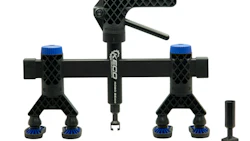
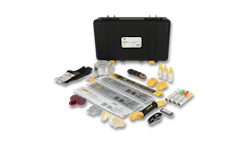
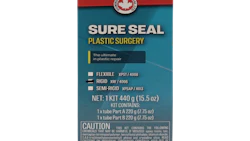
Dimovski says a shop can begin with proper training, a quality hot-air plastic welder, dent-pushing tools, compatible welding rod, tab-repair jigs and welding support tape. Consumable costs can be only a few dollars on many repairs, but equipment is only part of the equation.
“Technicians need to understand plastic identification, repairability, heat control and material compatibility,” says Dimovski. “They also need to know when not to repair.”
Training also ranks high in Collision Repair’s survey, reinforcing the need for technicians to have the knowledge and confidence to perform the work properly. Equipment sitting against the wall doesn't create a plastic-repair program. People who understand what to repair, how to repair it and when not to repair it do.
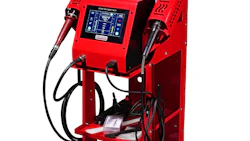
Lammon makes much the same point from the equipment side. “Plastic fusion welding with a nitrogen plastic welder can yield a high-quality repair that the shop can stand behind, assuming the technicians have adequate skills.”
Access to information is Mario Dimovski – President, Plasnomic,
Head of the Plastic Repair Alliance Council.
Alexy brings those elements together when considering whether a repair is appropriate. “Always reference the OEM procedures,” he says. “That is the most important part of determining whether a plastic component can or should be repaired or replaced.”
Once that hurdle is cleared, business considerations return. “Body shops make money off the sales of labor fixing cars,” Alexy says. “If a part can safely and effectively be repaired, it is an area of opportunity.”
Finding the labour
Skilled labour shortages provide another reason to take a fresh look at plastic repair. Not every operation needs to land on the bench of the shop’s most experienced body technician.
“Plastic is often easier to repair than metal components and can be done so by a less-skilled technician,” says Lammon. With proper training, that creates an opportunity to develop another skill set within the business, generate productive hours and leave senior technicians available for repairs that demand their experience.
Demand for those skills could grow considerably. Dimovski expects increasing use of plastics, combined with more expensive, complex and sometimes difficult-to-source replacement components, to move the industry further toward repair-first decision making. He also sees growing demand for trained specialists and centralized plastic-repair services.
Judging today’s plastic repair by an unsuccessful repair performed decades ago ignores how much has changed. Lammon doesn't mince words on that point.
“If you’re not doing plastic repair because you had one fail 20 years ago, you’re not staying up with the technology in the industry,” he says. “Get some skills and a plastic welder, and you’ll be using it several times a day.”
Alexy also expects plastic repair to return to the industry conversation as manufacturers continue incorporating plastics and composites into modern vehicles.
“What will determine repairability will still stem from OEM repair procedures,” he says. “The repair procedures will be the ultimate driver of the repair vs replace discussion.”
Opportunity is there, but so are the conditions. Shops need training, estimators need to recognize appropriate repairs and OEM procedures have to be checked. Proper equipment and materials must be used. Compensation has to make the work worthwhile, and everyone involved needs confidence that the finished repair is one they can stand behind.
Those aren't reasons to dismiss plastic repair. They're reasons to get better at it.
Next time a damaged bumper cover, headlight or plastic component lands in the shop, replacement may still be the right answer. But it shouldn't be the automatic one.
Sometimes it's worth taking a second look.