Britain's competition regulator is requiring AkzoNobel and Axalta to address concerns about their $25 billion merger by November 18, citing potential risks to competition in vehicle refinish coatings, while the European Union has already approved the deal with conditions requiring the sale of AkzoNobel's European refinish business.
- The CMA concluded the merger could result in higher prices and reduced quality for vehicle body shop repairers, with the combined business controlling 40-50% of UK market supply
- EU regulators approved the merger on November 6 with the condition that AkzoNobel divest its European refinish coatings business, including manufacturing sites and intellectual property
- The combined company would generate approximately $17 billion in annual revenue and be named Axanzo, with AkzoNobel shareholders owning 55% and Axalta shareholders 45%
- Practical switching barriers identified include manufacturer-specific scanning equipment, color databases, and mixing systems that make it difficult for bodyshops to change paint suppliers
- Management maintains an early-2027 completion target, pending outstanding approvals from the UK, Canada, and other regulatory bodies
Britain’s competition regulator has given AkzoNobel and Axalta until Nov. 18 to address concerns about their proposed merger, days after European Union regulators approved the transaction on condition that AkzoNobel sell its European vehicle refinish business.
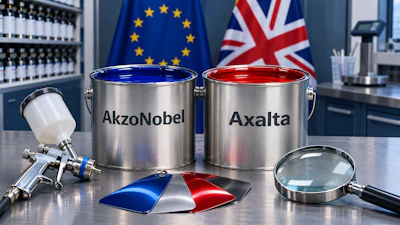
The decisions concern competition in the paints and coatings bodyshops use to repair damaged vehicles. Amsterdam-based AkzoNobel and Philadelphia-based Axalta announced their proposed all-stock combination in November 2025, valuing the combined business at approximately US$25 billion, including debt.
Britain’s Competition and Markets Authority (CMA) concluded Nov. 11 that the merger could leave repairers facing higher prices or reduced product quality and technical support.
The regulator estimated that the combined business would account for between 40% and 50% of British vehicle refinish coatings supply. Investigators found that the manufacturers compete closely through similar product ranges, technical support and extensive approvals from vehicle manufacturers and insurers.
Remaining suppliers would not provide enough competition to replace that rivalry, particularly in premium refinish products, according to the decision.
Unless acceptable commitments are offered, the CMA will refer the transaction for an in-depth investigation.
The European Commission reached similar conclusions about competition before granting conditional approval Nov. 6. Its investigation found that the four largest refinish coatings suppliers account for between 80% and 90% of sales across the European Economic Area. Axalta is the region’s largest supplier and AkzoNobel the fourth-largest. Each supplier outside the leading four has a regional market share below 5%.
European investigators also identified practical barriers to changing suppliers. Bodyshops rely on paint manufacturers’ scanning equipment, colour databases and mixing systems to match existing vehicle finishes, making switching more difficult than simply ordering another paint brand.
The commission concluded that the merger, as originally proposed, would likely increase prices for repairers and ultimately consumers. Claimed efficiency benefits were insufficient to offset the potential harm.
To secure approval, the manufacturers committed to selling AkzoNobel’s refinish coatings business in the European Economic Area. The package must include a dedicated manufacturing site with equivalent production capacity, intellectual property, personnel and other resources needed to operate the business.
The purchaser must already supply coatings or operate in a related industrial sector. The merger cannot be completed until the commission approves a suitable buyer, and an independent trustee will monitor compliance.
In their Nov. 11 update, management outlined plans to use the same divestment package to resolve the British concerns. The European business sale includes AkzoNobel’s British operations, but the European Commission’s approval does not settle the separate CMA review.
Canada’s Competition Bureau also lists its review as ongoing. The bureau’s public register records a March 18 opening date and does not report a clearance decision.
The proposed European divestment does not include an announced sale of Canadian refinish operations.
The merger would create a coatings business with approximately US$17 billion in annual revenue. AkzoNobel shareholders would own approximately 55% and Axalta shareholders 45%.
The proposed name is Axanzo. Greg Poux-Guillaume, AkzoNobel chief executive officer, would lead the combined business, with Chris Villavarayan, Axalta president and chief executive officer, serving as deputy chief executive officer.
“Receiving the European Commission’s approval is an important milestone as we move closer to completing our merger with Axalta,” Poux-Guillaume said in the Nov. 6 announcement.
Management maintained an early-2027 completion target in the Nov. 11 update, subject to outstanding approvals and closing conditions.