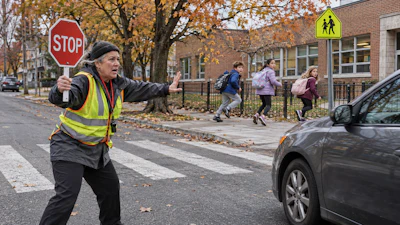
A Canadian study recorded 660 near misses involving pedestrians and vehicles at school crossings in 11 cities, with one in every 84 pedestrians experiencing a close call. Traffic controls like signals and stop signs reduced near-miss rates by approximately 95 percent compared to uncontrolled crossings.
- 660 near misses recorded over five school days at 30 locations across 11 Canadian cities using AI-powered traffic analysis
- Traffic controls reduce incidents by 95% — crossings with signals, stop signs, or roundabouts had one-twentieth the conflict rate of uncontrolled crossings
- Peak danger time: 5-6 p.m. — 94 incidents occurred during typical dismissal hour, compared to 242 across morning and afternoon school travel times
- School zone signs cut conflicts by 67% — crossings without speed-zone markings showed significantly higher conflict rates after accounting for traffic volume
- Automated speed enforcement works — Toronto study found 45% reduction in speeding when cameras operated, with speeds returning to normal after removal
One in every 84 pedestrians crossing at 30 locations on Canadian school routes was involved in a near miss with a vehicle, according to research released Nov. 12 by the Canadian Automobile Association.
Researchers identified 660 near misses over five school days at crossings in 11 cities. The association commissioned traffic technology provider Miovision and Winnipeg-based road safety engineering firm Fireseeds North Infrastructure to conduct the study.
Cameras recorded traffic from 7 a.m. to 7 p.m. Artificial intelligence software identified vehicles and pedestrians passing through the same point close together in time, then assessed the potential severity using vehicle speeds and the time separating them. Most incidents fell into the study’s medium-risk category.
“This study shows there is a lot of work still to do,” said Ian Jack, vice-president of public affairs for CAA National.
Traffic controls were associated with substantial differences in near-miss rates. Where approaching through traffic was controlled by signals, stop signs or roundabout yield requirements, the rate was approximately one-twentieth of that at crossings without those controls.
Crossings without school-zone or reduced-speed-zone signs had a 67% higher conflict rate after accounting for pedestrian and vehicle volumes.
Zebra-striped markings were associated with a 56% lower rate of conflicts involving turning vehicles exiting intersections. However, the researchers found mixed results when all conflict types were considered and cautioned against drawing firm conclusions about the markings’ overall effectiveness.
The busiest hour for near misses came after typical dismissal times. Researchers counted 94 incidents between 5 p.m. and 6 p.m., compared with 242 across the combined periods of 7 a.m. to 9 a.m. and 3 p.m. to 5 p.m.
Participating cities were Vancouver, Calgary, Edmonton, Saskatoon, Regina, Winnipeg, Ottawa, Toronto, St. Catharines, Montreal and Halifax.
The locations were selected with municipal staff and were not a random national sample. The findings identify associations between crossing features and near misses, without establishing that an individual feature caused the difference.
An earlier project by the same research partners, CAA’s 2025 Road Safety Innovation Labs report, examined 20 Canadian intersections using continuous monitoring and shorter video studies. Researchers recorded 616,854 conflicts across risk categories. Approximately one in 770 pedestrian crossings involved a high-risk or critical conflict, while right-turning vehicles accounted for 55% of pedestrian conflicts overall. That serious-conflict measure cannot be compared directly with the school study’s headline figure, which includes lower-risk events. The researchers identified pedestrian head starts, left-turn signal phases and compact intersection layouts among features associated with fewer conflicts.
For school-specific policy context, CAA’s 2022 report, Supporting Our Kids on the Journey to School, compared provincial and territorial approaches across 25 areas. Urban Systems transportation planners Jamie Hilland and Shoni Madden recommended dedicated funding, traffic calming, coordinated school-travel planning and monitoring to assess results. Their work reviewed policies and programs rather than measuring near misses.
A separate 2025 study published in Injury Prevention examined vehicle speeds before, during and after automated enforcement at 250 Toronto school-zone sites between July 2020 and December 2022. Researchers from the Hospital for Sick Children and Toronto Metropolitan University found that the proportion of vehicles speeding fell by 45% while cameras operated. Speeding returned to previous levels after their removal. The study measured speeds rather than changes in pedestrian injuries.
Research using collision records offers another comparison. A 2018 U.S. Federal Highway Administration evaluation estimated that pedestrian head starts at 105 intersections in Chicago, New York and Charlotte reduced pedestrian-vehicle collisions by approximately 13%. These signal arrangements typically let pedestrians begin crossing three to seven seconds before drivers receive a green light.