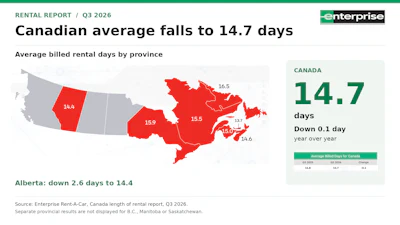
Canadian collision-related rental periods averaged 14.7 days in Q3, down just 0.1 day from the previous year, with improvements driven primarily by shorter total-loss and non-drivable claim rentals, while increased aftermarket parts availability and rising total-loss frequency continue reshaping the industry.
- National average collision rental period: 14.7 days in Q3, down 0.1 day year-over-year
- Total-loss rentals averaged 17 days, down 1.4 days; non-drivable claims averaged 25.6 days, down 0.7 day
- Aftermarket parts usage increased to 26.45% of replacement parts, up from 24.74% in Q3 2025
- Alberta recorded the largest improvement with average falling 2.6 days to 14.4 days, while five of seven provinces saw increases
- Average first-party deductibles rose $83 to $769, indicating consumer pressure from insurance premiums
Canadian collision-related rental periods edged down to 14.7 days in the third quarter, with shorter rentals for total-loss and non-drivable claims leading the improvement.
Enterprise Rent-A-Car’s Canadian length of rental report shows the national average fell 0.1 day from 14.8 days in Q3 2025.
The annual improvement was smaller than in the second quarter, when rental periods fell half a day year over year to 14.9 days.
Rentals associated with total losses averaged 17 days in Q3, down 1.4 days from a year earlier. Non-drivable claims averaged 25.6 days, a reduction of 0.7 day, while rentals associated with drivable vehicles edged down 0.1 day to 12.1 days.
Provincial results varied considerably, with five of the seven provinces reported recording longer rental periods.
Alberta had the largest improvement, with its average falling 2.6 days to 14.4 days. However, the report cautioned that the effects of hailstorms in July and August might not yet be fully reflected in the results.
Prince Edward Island retained the shortest average rental period at 13.7 days, despite recording the largest annual increase at 1.2 days.
Newfoundland and Labrador had the longest average among the provinces reported, rising 0.9 day to 16.5 days. Ontario increased 0.4 day to 15.9 days, while Quebec rose 0.8 day to 15.5 days.
New Brunswick edged up 0.1 day to 15 days. Nova Scotia joined Alberta in recording an improvement, falling 0.3 day to 14.6 days.
The report does not display separate provincial results for British Columbia, Manitoba or Saskatchewan, where public insurers operate.
The gap between drivable and non-drivable claims remained substantial.
Newfoundland and Labrador recorded the longest non-drivable rental period at 34.8 days, despite a 2.9-day annual reduction. Prince Edward Island followed at 30 days, then New Brunswick at 29.3 days.
Quebec had the shortest non-drivable rental period at 21.4 days. Alberta recorded a 5.9-day reduction to 26.6 days.
Among drivable claims, Ontario had the longest rental period at 13.3 days. Quebec had the shortest at 9.6 days.
The national improvement came as aftermarket parts accounted for a larger share of replacement parts.
Ryan Mandell, vice-president of strategy and market intelligence at collision estimating and claims software provider Mitchell International, said aftermarket parts represented 26.45% of replacement parts in Canada, up from 24.74% in Q3 2025.
“Improved availability of aftermarket parts post-pandemic is one of the factors that is driving the flattening of repairable severity,” Mandell said in the report.
Mandell also reported that total-loss frequency reached 24.8%, up from 24.1% a year earlier.
“Just as with the United States, with more borderline vehicles ending up as write-offs, this contributes to some of the reduction in repairable claims volume the industry has been experiencing,” he said.
Rental periods associated with writeoffs were longest in Prince Edward Island at 26.9 days, followed by Nova Scotia at 20.1 days and New Brunswick at 18.6 days.
Alberta recorded the shortest total-loss rental period at 15.8 days, down 3.1 days from a year earlier.
Canadian drivers were also carrying larger deductibles. The average first-party deductible reached $769, up $83, or about 12.1%, from $686 in Q3 2025.
Mandell said rising deductibles indicated that consumers remained under pressure from insurance premiums, with more competitive rates yet to reach Canada to the same extent as the United States.
“This is one of the main reasons we are still seeing sizable reductions in claims volumes across Canada,” he said.
The report measures average billed rental days for rentals billed directly to insurers through Enterprise’s ARMS system. The figures describe replacement rental periods rather than time spent actively repairing vehicles.