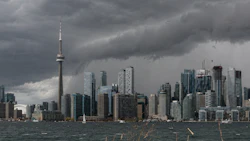
Severe thunderstorms account for 40% of modelled insured catastrophe risk worldwide, putting hail, wind and tornado damage ahead of every other natural perils measured by Verisk.
The New Jersey-based insurance data and analytics provider has calculated that insurers should be prepared for an average of US$171 billion in catastrophe losses annually. That is US$19 billion more than the 2025 estimate and the highest figure produced since Verisk began publishing the benchmark in 2012.
“A quiet hurricane season can lead markets to respond as if risk has eased: rates soften, insurers keep more risk on their own books, and more capital competes to write new business,” said Rob Newbold, president of Verisk Catastrophe and Risk Solutions.
“But 2025 reminds us that the underlying risk landscape has changed and years without significant losses from U.S. hurricane activity no longer signal a quieter catastrophe environment.”
Global insured catastrophe losses exceeded US$100 billion for the sixth consecutive year in 2025, despite the absence of a U.S. hurricane landfall. Record wildfires and severe thunderstorm activity accounted for much of the damage.
Severe thunderstorms represented 40% of the modelled average annual loss, followed by tropical cyclones at 27%, earthquakes at 10%, winter storms at 9%, floods at 7% and wildfires at 6%.
Verisk did not provide separate figures for automobile losses or Canadian claims.
The Insurance Bureau of Canada reported approximately 70,000 vehicle claims and roughly $1 billion in automobile damage following the August 2024 Calgary hailstorm.
“The $171 billion figure is not determined by the outcome of one hurricane season or one year of catastrophe losses,” said Jay Guin, executive vice-president and chief research officer for Verisk Catastrophe and Risk Solutions.
“It reflects a wide distribution of potential events across perils and regions, using current exposure data and a view of hazard grounded in the near-present climate.”
The United States accounted for US$117 billion, or 68%, of the modelled total. A year corresponding to a 1% annual probability would produce aggregate insured losses of US$477 billion. Losses would reach US$606 billion under a scenario with a 0.4% annual probability.
Property exposure across the countries covered by Verisk’s models has increased by approximately 7% annually since 2021. U.S. residential reconstruction costs have increased by approximately 5% annually over the same period.
Newbold said catastrophe modelling allows insurers to make pricing, capital and risk-transfer decisions across the full range of potential events “not just the outcome of a single season.”
Verisk analysts placed average global economic losses from natural catastrophes at more than US$450 billion annually. Approximately 38% of those losses are insured.
“Narrowing the protection gap requires broader access to insurance and a clear understanding of the risk,” Newbold said.