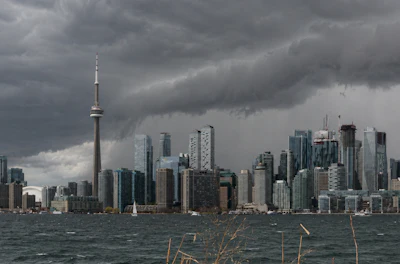
Collision businesses across southern Ontario are bouncing back after severe storms caused flooding in the Greater Toronto Area and other centres in southern Ontario.
The Sept. 2 storm brought intense rain, hail and damaging winds across the region. Environment and Climate Change Canada recorded preliminary rainfall totals of 138.9 mm in Caledon, 133 mm in Vaughan, 118.1 mm in North York and 105.9 mm in Scarborough.
Toronto and Region Conservation Authority gauges recorded between 10 mm and 112.4 mm, showing how sharply conditions differed between neighbourhoods. The authority said already saturated ground could not absorb much of the additional rain.
The storm had little effect on operations at Platinum Auto Collision in Toronto, according to owner Hugo Matos.
“It actually wasn’t that bad,” he said. “We close at five, so we were just getting ready to leave when the downpour started. There have been a few related claims through this.”
At Octopus Auto Body, owner Mustafa Abuzaid said the storm became intense around the shop, but the Eglinton-area property’s elevation helped protect the facility. "Things were wild,” Abuzaid said. "But we didn't get water coming inside."
Despite the conditions outside, he said the shop did not sustain serious damage and has not seen much additional repair work from the storm.
Dupont Auto Repair also avoided flooding, although its facility at 374 Dupont St. sits near the bottom of a hill and close to Casa Loma. The surrounding terrain can direct heavy runoff toward the area during intense rainfall.
A shop representative said the property’s layout, proactive maintenance and local street drainage prevented serious water accumulation. Customer vehicles, equipment and work areas remained dry, and the business continued operating normally.
The pattern extended beyond Toronto.
At Mazda of Hamilton, general manager Fraz Mirza said the Sept. 2 storm caused no significant problems -- likely because the dealership had already made preparations after experiencing flooding during two earlier storms this summer.
“If you recall, a couple of months ago, we had a crazy rainstorm,” Mirza said. “Our detail bay is underground, and it overflowed into the basement.”
The dealership prepared its equipment following that incident. Another flood struck one or two weeks later, but Mirza said the preparations helped the facility manage the water.
“A week or two after, we had another flood, so it’s been OK,” he said. “Then, the day before, we didn’t get anything.”
Conditions elsewhere were more severe. Environment Canada reported hail measuring between 2.5 cm and 6.5 cm in North York, where vehicle windshields and apartment windows were shattered. Radar indicated localized winds greater than 130 km/h, although the highest measured Toronto-area gust was 83 km/h at Pearson International Airport.
More than 150,000 Ontario electricity customers lost power, including approximately 65,000 Toronto Hydro customers and more than 50,000 Hydro One customers.
The City of Toronto declared a significant weather event. By noon on Sept. 4, the city had received approximately 2,400 storm-related service requests involving flooding, fallen trees, debris and other damage.
Bayview Avenue was temporarily closed, fallen trees blocked vehicle access to High Park and power outages affected several traffic signals. Environment Canada also reported significant damage at Rogers Stadium, partial roof damage at the Woodbridge Soccer Centre and the destruction of a barn near Brucefield.
No insured-loss estimate had been released immediately after the storm. The Insurance Bureau of Canada said damage to vehicles from flooding, hail, wind and falling objects is generally covered only when the owner has purchased optional comprehensive or all-perils coverage. Mandatory Ontario automobile insurance and collision coverage alone generally do not cover weather damage.
The storm follows years of rising severe-weather losses. IBC has reported that insured damage from severe weather averaged more than $3.7 billion annually over the past decade, compared with $1.4 billion during the preceding decade.
Flooding in southern Ontario on July 15 and 16, 2024, eventually produced an estimated $890 million in insured property and automobile damage. While the full cost of the latest storm remains unknown, the collision facilities contacted for this story reported few claims, little physical damage and no lasting interruption to their operations.