
I COULDN’T BE PROUDER OF THOSE YOUNG PEOPLE WHO CARRIED THE PARR LEGACY TO HEIGHTS I NEVER IMAGINED — PROVING, ONCE AGAIN, THAT KNOWING WHEN TO STEP ASIDE CAN BE JUST AS IMPORTANT AS KNOWING WHEN TO STEP IN.
As I approach the twilight of my career as executive director of the Saskatchewan Association of Automotive Repairers (SAAR), I’m happy to provide an update on where our organization has been — and where I hope it is headed next.
It’s hard to believe that it’s been nearly 10 years since I sold my interest in Parr Auto Body to five key employees. Four are still managing the business today very successfully. I couldn’t be prouder of those young people who carried the Parr legacy to heights I never imagined — proving, once again, that knowing when to step aside can be just as important as knowing when to step in.
It has also been nine years since I assumed the role of executive director, following a year of travel and the construction of a lake home about an hour and a half north of Saskatoon. The truth? I got bored. I still felt I had something to give back to the industry.
When I was hired by the SAAR board, there was concern I might damage our relationship with our sole insurance provider, Saskatchewan Government Insurance (SGI). I had a reputation for being — let’s say — fairly outspoken about how auto bodyshops were treated in our province. Fortunately (for me, and possibly for SGI), a change in SGI’s upper management brought in a younger, more open-minded leadership group.
While we experienced some initial friction, it became clear that SAAR’s goal was simple: an honest working relationship focused on safe, quality repairs. As those concerns eased, we began working together to develop a robust accreditation program requiring up-to-date equipment and training, primarily through I-CAR. We did lose about 20% of our previously certified shops, but in all honesty, many were not equipped to handle the technology found in today’s vehicles.
Over the years, we developed a Technical Sub-Committee to address emerging issues. While no system is perfect, I can confidently say SGI has — after extensive consultation — allowed most OEM procedures to appear on estimates. Pre- and post-repair scans are just one example, and I’d wager we were among the first jurisdictions to receive compensation for them.
We also boast one of the highest labour rates in the country, and quite possibly the highest paint material rate. Yet after using Yanni Koutmos’s Eagle MMS material management software, I can assure you it’s still not high enough. More on that at a later date. Another important initiative we launched with SGI is the Adjuster Working Group.
This committee came together largely thanks to Jessica Hill Flaman, who attended one of our town hall meetings and heard the stories of strained communication between shops and adjusters. Progress has been slow, but meaningful. We’re learning to understand each other’s pain points — and yes, we’re discovering that both sides have real headaches.
This challenge has been amplified by SGI’s “digital transformation,” which has left us straddling the old system and the new Guidewire platform. If you’ve ever introduced new software or hardware into your shop, you’ll understand the growing pains — now multiply that by about a thousand. It’s tough slogging, but we’re committed to working through it, and we appreciate SGI’s willingness to seek our input.
A key part of our relationship with SGI is recognizing their challenges and helping to address them. Chief among these is the rising cost of repairing today’s highly sophisticated vehicles. Average repair severity has more than doubled in the past 12 years, yet SGI has not seen an insurance rate increase since 2014.
This is largely a political issue. Governments don’t like raising costs for the driving public — particularly when an opposition party is waiting in the wings. SAAR met with the Minister responsible for SGI not asking directly for increased shop compensation, but to advocate for insurance premiums that reflect today’s repair realities. Our belief is simple: reasonable rate increases make fair compensation negotiations more achievable.
We also have other initiatives underway that could potentially lower SGI’s costs while improving shop profitability and reducing administrative burdens.
The first is a Repair-Versus-Replace mindset. With advanced metal repair techniques such as Betag Innovation and glue pulling, properly trained shops can now repair panels that were once considered replace-only. SGI benefits from reduced claims costs, while shops earn higher-margin labour hours. Add faster cycle times and environmental benefits, and it’s a rare triple win.
A KEY PART OF OUR RELATIONSHIP WITH SGI IS RECOGNIZING THEIR CHALLENGES AND HELPING TO ADDRESS THEM.
The second initiative is a Parts Autonomy program, which allows shops to choose whichever parts make the most sense for a repair — as long as SGI sees an overall savings on OEM parts pricing. If an aftermarket or recycled part creates fitment concerns, we can opt for OEM. When alternatives make sense, shops can realize the required savings margin. The goal is to meet SGI’s Realized Parts Savings target over a three-month period. We’re currently in a soft rollout phase until the end of June 2026, with a full launch planned for July 1. We believe this will be a genuine win-win.
Today, SAAR represents collision repair shops, paintless dent repair companies and auto glass installers. Could we expand into towing? Mechanical repair? Auto wreckers? Those are questions the next generation of leadership will need to tackle — hopefully with enthusiasm and strong coffee.
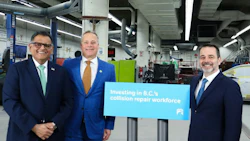
Another area of expansion has been our support for pre- and post-secondary automotive repair education. As education budgets tighten, SAAR has stepped in with funding and mentorship. SGI recently contributed approximately $200,000 toward these programs, which we greatly appreciate — but more is needed. ICBC, for example, has announced a $13-million, multi-year investment in auto trades education in British Columbia.
Attracting and retaining young people has always been a challenge in our industry, but they’re out there. They’re looking for meaningful, hands-on careers — we just need to show up and introduce ourselves.
Looking ahead, SAAR has found a successor for the Executive Director role, with Jake Korolis set to take over the position. Jake is a sharp and capable young professional with a strong background in business development, problem-solving, and organizational leadership — skills that will serve SAAR and its members well moving forward. Look forward to his column in this magazine going forward.
From my vantage point, I would love to see a national association similar to what CCIF was originally intended to be: a forum where shop owners, insurers and suppliers could openly discuss challenges and develop solutions. Somewhere along the way, it evolved into more of a networking event. While networking is valuable, true collaboration is better.
I strongly believe that if industry stakeholders work together, we can vastly improve our working relationships. Time will tell — but I remain optimistic.