AN INSIDE LOOK AT THE 2026 OARA CONVENTION & TRADE SHOW

"From my perspective it all went very well," said Wally Dingman, OARA's executive director. "We had record attendance, raised $37,000 for industry scholarships and had a lot of important and productive conversations with key figures throughout the automotive aftermarket — and even in government."

"We focused on how AI is actually being used inside the industry, not just what might happen," said Steve Fletcher, who continues to serve as an industry ambassador and consultant following his retirement as OARA's long-time executive director. "In the past, it was hypothetical. Now people are showing what's already happening."
Fletcher pointed to imaging tools as a concrete example. "You can take multiple images of a vehicle, and the system identifies components, flags damage and aligns that directly into your inventory," he said. "That's a real productivity gain."
But while AI drew attention, much of the conversation — and concern — centred on fundamentals: training, safety and the industry's place in a rapidly changing vehicle landscape. That perspective came through most clearly in remarks from Wally Dingman, executive director of both OARA and the Automotive Recyclers of Canada, who argued that recyclers are still fighting for recognition as a core part of the automotive lifecycle. "We are part of the process," Dingman said. "You can't design a system for vehicles without thinking about what happens at the end of life. If recyclers aren't at the table, then you're missing a piece."

"When we collaborate and raise issues together — things like VIN management and traceability — government starts to pay attention," he said. "The minister told us directly that we're bringing a perspective they hadn't fully considered."
The Ontario's Associate Solicitor General decision to speak at the conference is being hailed as a major achievement for the association, especially as it had been the province that reached out to secure the opportunity.
"Having that opportunity to speak directly with government is important."
Fletcher noted the presentation helped generate excitement for the event. "When we announced he was coming, registrations jumped. It put auto recyclers on the radar in a positive way. The real value is in the conversations that follow."
Those conversations are expected to continue. OARA board chair Greg Woodbeck confirmed that follow-up meetings are already being planned.
"We've just made that connection," Woodbeck said. "Now it's about sitting down and continuing the dialogue about how we can contribute."
Alongside policy, Dingman identified electric vehicles as the most pressing operational challenge facing recyclers today — not because of uncertainty about EV adoption, but because of safety.
"This is the first time in automotive history where the new technology can actually kill you if you don't understand it," he said. "We've always figured things out as we go, but that approach doesn't work with highvoltage systems."
Training, he said, is both essential and hard to scale.
"The training exists, but it's expensive," Dingman said. "We need support — whether from government or manufacturers — to make it accessible."
The challenge is compounded by workforce turnover, which can force operators to repeatedly invest in the same training. "You train someone, and if they move on, you have to start again."
Despite those pressures, Dingman said the industry has adapted to every major technological shift it has faced. "Every time something new comes along, people think the industry is finished. But we learn it, we adapt and we move forward."
He also stressed the need to reduce delays in getting parts into inventory systems. "In the past, parts might not get listed for days, sometimes without proper identification. Now the focus is on getting parts online quickly and accurately so they can sell faster."
Keynote speaker Jer Banta addressed operational discipline in a session titled Effective Qualifying, Overcoming Objections, and Closing More Sales. "We were moving a lot of volume but not making the money we should have," he said. "The turning point was putting proper systems in place — tracking performance, creating accountability and getting organized. Without that, the business doesn't hold together."

That theme was echoed by Shannon Nordstrom, president of the Automotive Recyclers Association, who noted that margin pressure has fundamentally changed the business. "Back in the '90s, we didn't have to think too hard about what vehicles we bought — margins were strong. Today, it's a much harder nut to crack." Nordstrom pointed to compensation strategy as one lever, noting that his operation provides quarterly bonuses to all full-time staff. Beyond individual sessions, the convention emphasized coordination across the supply chain. Opening-day roundtables brought recyclers together with insurers, repairers and data providers to surface shared challenges.
"We brought those groups together to understand each other better," Fletcher said. "They don't always have the chance to sit down and talk through these issues." He described closer alignment with the collision sector as critical. "When we're aligned, you get better results on cycle time, part quality and availability."
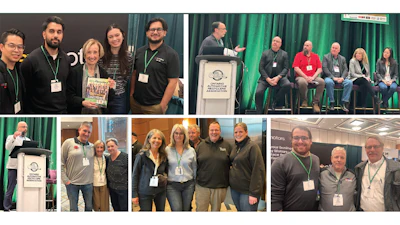
OARA leadership said the event's scale and energy reflected that broader momentum. "It was our biggest show so far," Woodbeck said. "Strong attendance, a busy trade floor and full rooms."
INSIDE CARCONE: CUTTING-EDGE RECYCLING FACILITY OPENS ITS DOORS
Delegates at the 2026 OARA Convention and Trade Show, attended the kick-off event, where owner Michael Carcone led guests through each stage of the recycling process. The walkthrough traced a part’s path from the vehicle compound through dismantling, into inventory storage and ultimately packaging for distribution, offering a clear view of how recycled components are processed and prepared for market.
collisionrepairmag.com/15820838