Dutch automotive coatings manufacturer AkzoNobel saw operating income fall in 2024 even as it managed to grow its underlying business and lift bottom-line profit.
The company, whose Sikkens and Lesonal brands are among the most widely used paints in collision repair shops globally, brought in US$11.17 billion ($15.49 billion) for the year ended Dec. 31. Underlying sales — stripping out currency moves — grew 2%, but that was largely offset by sharp currency depreciation in several emerging markets. Operating income fell to US$955 million ($1.32 billion) from US$1.07 billion ($1.49 billion) the prior year, weighed down by restructuring charges. Adjusted operating profit, which excludes those one-time costs, rose 3% to US$1.54 billion ($2.14 billion). Net profit climbed 23% to US$565 million ($784 million).
The performance coatings division — home to the company's automotive refinish, vehicle OEM coatings and other industrial businesses — generated around US$6.67 billion ($9.25 billion) in revenue, making it the larger of AkzoNobel's two main units. Automotive demand was uneven through the year, reflecting broader weakness in vehicle production and repair volumes across key markets.
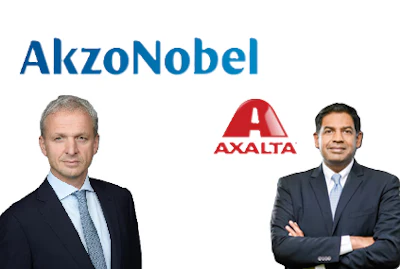
Chief executive Greg Poux-Guillaume (left) acknowledged the difficulty but struck an optimistic tone. "Although these headwinds spurred competitive intensity and tested our resilience, they also strengthened our determination to control our own destiny by stepping up self-help measures that ultimately boosted our performance," he said.
On the environmental side, AkzoNobel said it has cut its direct and energy-related carbon emissions — known as Scope 1 and Scope 2 — by 41% since 2018 and now draws 65% of its electricity from renewable sources, against a target of halving those emissions by 2030. The annual report expanded its sustainability disclosures to comply with new EU rules requiring large companies to publish standardized data on their environmental footprint and supply chain risks.
Poux-Guillaume said the company is targeting adjusted operating profit above US$1.62 billion ($2.24 billion) in 2025. "We're making AkzoNobel stronger, more dynamic and more competitive. This will serve us well when our end markets start growing again," he said.
The mixed set of results, revealed in its latest quarterly report, come as the company prepares for a transformative merger with Axalta that has the potential reshape the global automotive paint market.
The company's planned merger with Axalta Coating Systems was announced in November 2025. The all-stock deal would create a coatings giant with an enterprise value of around US$25 billion ($34.67 billion),and would significantly reshape the global automotive paint market. Axalta posted roughly US$2.16 billion ($3 billion) in refinish revenue in 2024 and US$1.82 billion ($2.52 billion) in OEM mobility coatings — numbers that, combined with AkzoNobel's own vehicle coatings operations, would give the merged company commanding positions in both the new-vehicle and collision repair paint markets.
AkzoNobel shareholders would hold 55% of the combined entity, with Axalta shareholders taking 45%. Closing is expected in late 2026 or early 2027, pending shareholder and regulatory approval. Poux-Guillaume will run the combined company, with Axalta chief Chris Villavarayan (right) serving as his deputy.