Electric vehicle collision claims hit record highs in 2025 even as BEV sales cooled and repair costs edged down.
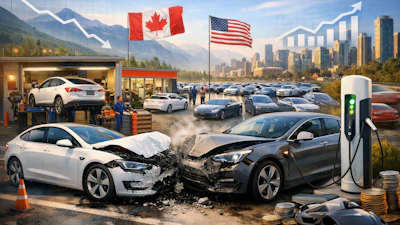
That tension is a central theme in the 2025 year-in-review edition of Plugged-In: EV Collision Insights from Mitchell. The data shows that in the third quarter of 2025, battery electric vehicles accounted for 3.21 percent of all repairable collision claims in the United States, up 4.2 percent year over year. In Canada, BEVs reached 4.91 percent of repairable claims in the same period, a 24.3 percent jump from a year earlier.
At the same time, BEV sales momentum softened after incentive changes. The report notes U.S. BEV purchases declined about two percent from 2024 following the expiration of certain federal tax credits, even as the number of BEVs on the road continued to grow.
Repair costs, meanwhile, showed signs of moderation. In the third quarter, average repairable severity for BEVs was $6,185 in the U.S. and $6,954 Canadian in Canada, down 2.4 percent and 1.5 percent respectively from the prior quarter. BEVs still cost more to repair on average than internal combustion engine vehicles, but the gap narrowed slightly as parts pricing and procedures stabilized.
Ryan Mandell, vice-president of strategy and market intelligence at Mitchell, framed the shift this way: “While EV adoption growth has slowed in some areas, the number of electrified vehicles on the road continues to rise, and that’s reflected in the collision claims data.”
He added: “As the car parc continues to evolve, insurers and repairers need to understand how these vehicles perform differently in a collision environment.”
Parts mix remains one of those differences. In the third quarter of 2025, BEV repairs used original equipment manufacturer parts for roughly 85 percent of parts dollars, compared with about 62 percent for ICE vehicles. That heavier reliance on OEM parts contributes to higher repair bills and can extend cycle times depending on availability.
Geography matters too. Provinces and states with higher BEV adoption rates post much higher collision shares. In Q3, British Columbia saw BEVs account for 8.74 percent of repairable claims, Quebec 8.37 percent and California 6.50 percent.
Market share among manufacturers is shifting underneath those numbers. Tesla’s share of the U.S. BEV market slipped to 46.2 percent from 48.7 percent in 2024, while competitors including General Motors, Honda and Volkswagen gained ground in electrified segments.
The broader takeaway is straightforward. Sales volatility does not immediately translate into fewer EV collisions. The vehicles already in driveways and fleets continue to generate claims, and their repair profiles remain distinct.
“EVs aren’t a niche anymore,” Mandell said. “They’re part of the mainstream fleet, and the collision industry has to treat them that way.”