A water film less than one millimeter thick can severely weaken the radar signals that cars use for adaptive cruise control, according to a study by Quebec researchers published in Electronics. The researchers found that 0.8 millimeters of water on a radar cover could eliminate nearly all of the returning signal's power, potentially causing the radar to stop functioning.
- A water film just 0.8 mm thick on a radar cover can eliminate almost all returning signal power, reducing it to less than 0.001% of normal levels
- Heavy rain between two cars 250 meters apart reduces radar signal power by approximately three-quarters, according to lab calculations
- Automotive radar sensors send out radio waves to detect vehicles ahead and adjust speed for adaptive cruise control systems
- Excessive signal loss can force radar into degraded-mode operation or complete failure, compromising vehicle safety
- Researchers plan to test working automotive radar systems to determine maximum detection distance with water on the sensor cover
A film of water less than a millimetre thick can weaken the radar signal some cars use for adaptive cruise control, Quebec researchers report in a Nov. 24 study in Electronics.
Some cars have a forward-facing radar sensor behind the grille or bumper cover. The sensor sends out radio waves and picks up the echoes. Adaptive cruise control uses those echoes to judge how far away the vehicle ahead is and adjust the car’s speed.
Wafa Farah investigated the effect of water for her master’s degree in engineering at the Université du Québec à Rimouski. She wrote the paper with Chan-Wang Park, an engineering professor at the university. Electronics is a peer-reviewed journal.
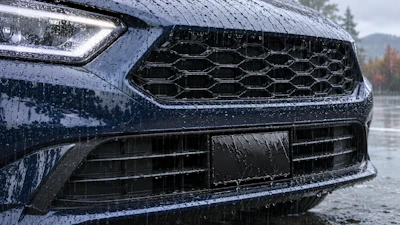
According to the findings, a film of water just 0.8 mm thick on the radar cover could wipe out almost all of the returning signal’s power, the researchers calculated from their lab tests.
Less than 0.001% of the power that would reach the sensor through a dry cover would get through. In a separate calculation, heavy rain falling between two cars 250 metres apart cut the returning signal’s power by about three-quarters.
The researchers calculated the 52-decibel loss from a lab test of the wet cover. The test measured one pass through the cover. A car’s radar signal passes through it twice, once on the way out and again when the echo returns.
The researchers found that “signal attenuation increases sharply with water film thickness.” A large enough loss can cause the radar to “enter degraded-mode operation or even stop functioning altogether,” they wrote.
Farah and Park used a Teflon cover about 10 times as thick as the typical production cover described in the paper. They plan to test a working automotive radar to find out how much water on the cover reduces the distance at which it can detect a vehicle.