Three new SUVs failed to brake in time to avoid a car turning into their lane during American Automobile Association tests, even though their safety sensors had been calibrated before testing.
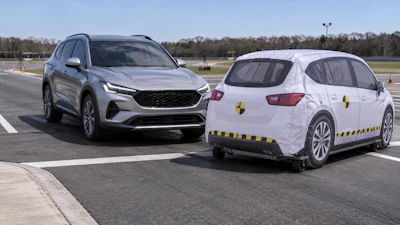
Researchers used a moving, collapsible target shaped like a car. Each SUV had braking technology specifically intended to help prevent intersection crashes.
In the first test, the SUV approached an intersection at 48.3 km/h (30 mph). The target car entered from a side road and turned right into the SUV’s lane.
The Model Y stopped short of the target in all five attempts.
The Equinox hit it in all five attempts. Its system warned of a collision four times but applied the brakes only once. The Explorer and Tucson each hit the target three times without issuing a warning or braking automatically.
Three new SUVs failed to brake in time to avoid a car turning into their lane during American Automobile Association tests, even though their safety sensors had been calibrated before testing.
In another test, a Hyundai Tucson avoided a collision when its left-turn signal was on but hit the other vehicle when the signal was off.
The study, released Nov. 12, tested automatic emergency braking (AEB) on four 2026 models: the Chevrolet Equinox, Ford Explorer, Hyundai Tucson and Tesla Model Y. These systems are supposed to apply the brakes automatically when they detect an imminent collision.
Researchers used a moving, collapsible target shaped like a car. Each SUV had braking technology specifically intended to help prevent intersection crashes.
In the first test, the SUV approached an intersection at 48.3 km/h (30 mph). The target car entered from a side road and turned right into the SUV’s lane.
The Model Y stopped short of the target in all five attempts.
The Equinox hit it in all five attempts. Its system warned of a collision four times but applied the brakes only once. The Explorer and Tucson each hit the target three times without issuing a warning or braking automatically.
The researchers called this “a major capability gap.”
The second test reversed the situation. This time, the SUV turned left in front of an oncoming target car. With the SUV’s turn signal on, all four models braked and avoided a collision every time.
Researchers repeated the test with the turn signal off. Three models still avoided a collision, but the Tucson hit the target in all three attempts without warning or automatic braking.
“System robustness should not depend on protocol-specific conditions such as turn signal activation or idealized steering inputs,” the researchers wrote.
Before testing, each SUV received sensor calibrations, a wheel alignment, a brake inspection and current software. Researchers also checked for damage and warning lights.
The results show that a system can be correctly prepared and still fail to prevent certain intersection crashes.
AAA conducted the study with the Automobile Club of Southern California’s Automotive Research Center. The report identifies John Partridge as AAA National project lead.
Researchers completed 74 test runs in controlled daytime conditions. They recommend testing more types of intersection crashes and improving systems so their responses are more consistent.