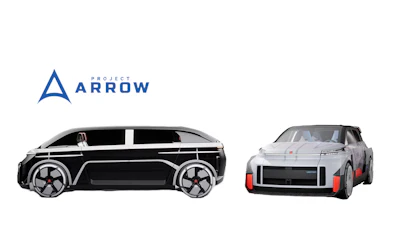
Canada's automotive parts industry used the 2026 Canadian International AutoShow to unveil two made-in-Canada electric vehicle prototypes, marking the next phase of a national innovation program aimed at proving the country can design and build its own zero-emission vehicles.
The Automotive Parts Manufacturers' Association revealed the Project Arrow Vector and Project Arrow Borealis on media day, Feb. 12, at the Metro Toronto Convention Centre. The twin debuts represent Phase 2.0 of the Project Arrow program, which first produced a Canadian-designed zero-emission concept vehicle in 2023.
Vector is a near-term platform engineered to demonstrate commercially scalable Canadian technologies. It features an AI-formed, 3D-printed lightweight polymer and aluminum chassis, a 650-horsepower all-electric powertrain, an estimated range of 550 kilometres and Level 3 autonomous functionality.
Borealis takes a longer view, serving as a research and design platform exploring Canadian mobility and infrastructure beyond 2040. It targets Level 5 full autonomy, smart cities connectivity, an AI-designed 3D-printed metal-alloy chassis and a projected range of 1,500 km.
Ontario Tech University is the lead build partner, supporting engineering integration and prototype assembly. More than 80 Canadian suppliers and ecosystem partners contributed technologies and materials across both prototypes. Funding comes in part from the Federal Economic Development Agency for Southern Ontario and the Ontario Vehicle Innovation Network.
"Project Arrow began as a national ambition to prove that Canada could design and build its own zero-emissions vehicle," said Flavio Volpe, president of the APMA. "With Phase 2.0 we are advancing that platform into the technologies, systems and industrial capabilities that will define mobility in the 2030s and 2040s."
The Arrow unveilings were among the highlights of the autoshow, which ran Feb. 13-22 and drew more than 40 brands under the theme Driven by Choice. The event showcased a broad mix of internal combustion, hybrid and battery-electric vehicles set to enter Canadian markets in the coming model years.
Toyota used the Toronto stage to highlight the Ontario debuts of the 2026 C-HR and 2026 bZ Woodland. Stellantis Canada president Trevor Longley said his company's presence was designed to reinforce priorities around value and safety. BMW Group Canada president and CEO Andrew Scott said the brand's electric display was meant to engage both EV enthusiasts and performance drivers.
Show general manager Jason Campbell said the floor was structured for hands-on access, with visitors able to sit in vehicles on display and drive many of the most popular new models.