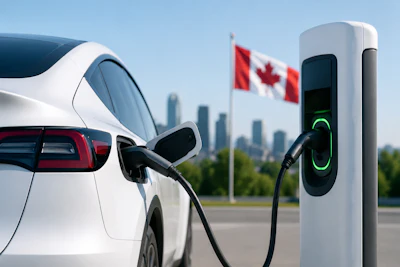
Canada is replacing its strict EV sales quotas with more flexible greenhouse gas emissions standards for vehicles from 2027 to 2032, allowing manufacturers to use battery-electric vehicles, plug-in hybrids, and efficient combustion engines to meet requirements. However, uncertainty persists as detailed regulations remain unpublished and U.S. tariffs add pressure to the automotive sector.
- Canada's Electric Vehicle Availability Standard is being replaced with new fleet-wide emissions limits for 2027-2032 model-year vehicles, announced by Prime Minister Mark Carney on February 5.
- The new system offers manufacturers greater flexibility to use battery-electric vehicles, plug-in hybrids, conventional hybrids, and efficient combustion vehicles to comply with regulations.
- Federal targets aim for 75% EV sales by 2035 and 90% by 2040, though detailed regulations have not yet been published.
- A 50% U.S. tariff on certain Canadian products took effect August 19, adding pressure to cross-border automotive relations and complicating the regulatory transition.
- Canadians have used only $270 million of $2.275 billion allocated to the Electric Vehicle Affordability Program, which offers up to $5,000 for battery-electric vehicles.
Canada’s plans for new vehicle-emissions rules are taking on greater significance as a new round of U.S. tariffs adds pressure to the country’s automotive sector.
An additional 50% U.S. tariff on certain Canadian products came into effect on Aug. 19 under Section 338 of the U.S. Tariff Act. U.S. President Donald Trump’s July 20 proclamation specifically targeted Canada’s treatment of American motor vehicles, adding another issue to an already strained cross-border automotive relationship.
The dispute comes as Canadian officials prepare to replace the Electric Vehicle Availability Standard with new greenhouse gas regulations for 2027 through 2032 model-year vehicles.
Prime Minister Mark Carney announced the change Feb. 5. The previous rules called for zero-emission vehicles to reach 60% of new light-duty vehicle sales by 2030 and 100% by 2035.
Under the replacement system, manufacturers will instead have to meet increasingly stringent fleet-wide emissions limits. Federal officials have said manufacturers will initially have greater freedom to use battery-electric vehicles, plug-in hybrids, conventional hybrids and more efficient combustion vehicles to comply.
Mark Cauchi, director general of energy and transportation with Environment and Climate Change Canada’s Environmental Protection Branch, described that flexibility during an April 20 appearance before the House environment committee.
“What they cannot do is avoid reducing emissions further,” Cauchi said. “This will be non-negotiable.”
Federal officials have said the new standards are intended to put Canada on a path toward EVs accounting for 75% of new-vehicle sales by 2035 and 90% by 2040. Detailed regulations have not yet been published.
The uncertainty comes as Canadian and U.S. officials negotiate broader automotive trade issues and prepare for the review of the Canada-U.S.-Mexico Agreement. Vehicle production, tariffs and North American content requirements have emerged as significant points of contention.
Meanwhile, new federal figures suggest Canadians have so far used only a fraction of the money allocated to Ottawa’s latest EV incentive program.
Transport Canada reported Aug. 6 that $2.05 billion of the $2.275-billion Electric Vehicle Affordability Program remained available as of Aug. 1. The program began covering eligible purchases and leases Feb. 16.
Buyers can receive up to $5,000 toward eligible battery-electric and fuel-cell vehicles and up to $2,500 for plug-in hybrids.