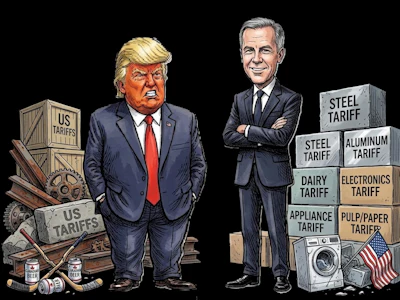
Canada launched a multi-billion dollar retaliatory tariff campaign against the United States, imposing duties ranging from 15% to 50% on approximately 700 American products effective September 8, after trade negotiations collapsed and the US threatened Canadian manufacturing sectors including autos, steel, and aluminum.
- Canada imposed counter-tariffs of 15% to 50% on roughly 700 US product categories effective September 8
- Top-tier duties of 50% apply to US steel, aluminum, video game consoles, clothing, and furniture
- Secondary tier of 25% targets agricultural machinery, dairy products, seafood, and household appliances
- PM Carney cited US attempts to destroy Canadian industries in autos, steel, and aluminum as reasons for walking away from negotiations
- Relief measures include expanded Employment Insurance eligibility and tariff exemptions for Canadian businesses dependent on US inputs
The federal government launched a targeted, multi-billion-dollar trade counter-offensive against the United States Tuesday, retaliating with sweeping import levies while accusing Washington of attempting to "destroy" Canada's key manufacturing sectors.
The retaliatory package, detailed by government ministers in an official release, imposes duties ranging from 15% to 50% across approximately 700 American product categories. The counter-measures will take effect Sept. 8, fulfilling Prime Minister Mark Carney’s vow to strike back "dollar for dollar" after cross-border trade negotiations collapsed late last week.
The sudden escalation follows Washington’s decision over the weekend to slap 50% tariffs on roughly $28 billion worth of Canadian goods — ranging from lumber and honey to cement and hockey equipment — by invoking Section 338 of the Great Depression-era Tariff Act.
Technical documents released by the Department of Finance outlined Ottawa's new duties:
A top tier of 50% duties will apply to U.S. steel and aluminum imports — raising existing 25% duties to match Washington's rate — as well as video game consoles, digital recording gear, clothing, furniture, and select consumer electronics.
A secondary tier of 25% duties will be levied on American agricultural machinery, pulp and paper, wood products, and major food commodities, including U.S. cheese, dairy products, and frozen seafood. Household appliances — such as washing machines, stoves, and refrigerators — along with carpets and textiles will also face the 25% tax.
A 15% duty will be placed on a wide range of American secondary manufactured items, plastics, lighting fixtures, and packaged consumer goods.
Furthermore, existing 25% tariffs on U.S.-assembled motor vehicles failing to meet regional content rules will remain in full effect.
Addressing reporters in Ottawa, Prime Minister Mark Carney pulled no punches regarding why Canadian negotiators walked away from the bargaining table.
"An attitude at the negotiation table that Canada is a subsidiary of the United States, that Canadian industry is going to be disadvantaged relative to American industry, that we are going to set up terms so that over time, Canadian industry is going to face constant headwinds — that's not something we're going to accept," Carney said.
Carney elaborated on the breakdown, noting that American terms posed a direct threat to domestic production.
"We learned during the negotiations that the Americans want to destroy our major industries, including autos, steel, and aluminum," Carney stated. "That was one of the main reasons we said no. It was a bad deal."
The Prime Minister added: "Last spring, I warned that America is trying to break us so that they can own us. And I promised: 'That will never, ever happen.' We are keeping that promise."
The diplomatic collapse sparked a fierce cross-border exchange over social media. U.S. President Donald Trump posted a series of statements on Truth Social, threatening to penalize Canadian vehicle exports if Ottawa proceeds with retaliatory duties.
"Canada has been ripping off the United States of America for years," Trump posted on Truth Social. "Their ridiculously high tariffs on our Farmers and farm products have made life impossible for these great American Patriots... On January First, 2027, Tariffs on all Cars, Trucks, both large and small, Automotive Parts, and Steel, will be increased to 50%. Built in the U.S., and there are ZERO TARIFFS. Canada will be treated like a State no longer!"
Trump later added: "I deal with many countries, and Canada is easily the most difficult and unreasonable. They feel entitled, but they are not a State, and will be entitled no longer! WE DON'T NEED CANADA, THEY NEED US!"
The U.S. President also launched personal broadsides against Ontario Premier Doug Ford, referring to him as "the less charismatic, intelligent, and overall unimpressive brother of the late, great Rob Ford" and calling him a "flunky."
Ford responded directly during press scrums and in a post on X.
"Up here, we're at a fever pitch; everyone's in for an economic war," Ford posted. "They know they're going to have to sacrifice, but we will protect our workers."
Speaking to reporters, Ford brushed off the personal attacks and warned that Ontario could use energy exports as leverage.
"He can kiss my ass as far as I'm concerned," Ford said, adding that Ontario is prepared to cut off electricity exports or hike power rates to neighboring U.S. states if the trade dispute worsens.
In an official joint statement released by the Prime Minister's Office following a virtual meeting with provincial leaders, federal and provincial governments pledged a coordinated defense.
"The Prime Minister and the leaders discussed the ongoing response and underscored the importance of a united Team Canada approach as Canada works to protect jobs, build the economy, and stand up for Canadian interests," the PMO release read.
Meanwhile, Conservative Leader Pierre Poilievre released a social media statement demanding total transparency over the collapsed negotiations.
"In a crisis that defines the future of our people and our country, Conservatives are ready to return to Parliament, to act with the urgency our people demand, and to put Canada first," Poilievre posted on X. "Let's be clear: there are no national secrets in that text. The president has seen it. His negotiators have seen it. The United States has seen it. Canadians deserve to see it."
To cushion domestic firms and workers from economic spillovers, the Department of Finance announced parallel relief measures, including an immediate expansion of Employment Insurance (EI) eligibility and a formal remissions framework to grant targeted tariff exemptions for Canadian businesses reliant on non-substitutable U.S. inputs.