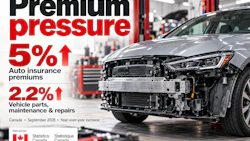
Canadian vehicle repair prices and insurance premiums are rising at different rates, with repairs climbing 27% since 2019 compared to 24% for premiums. This gap reflects advanced vehicle technology increasing repair complexity, fewer minor collisions being reported, and higher average claim costs, while electric vehicle repair expenses continue narrowing compared to gasoline vehicles.
- Between 2019 and 2025, repair prices increased 27% while insurance premiums rose 24% in Canada.
- Advanced driver-assistance systems and sensor calibration now appear in 28.3% of repairable estimates, adding significant repair costs.
- Vehicles with crash-avoidance technology have 10% higher average collision claim costs but 5% lower overall collision losses due to fewer crashes.
- Electric vehicle repair costs averaged $6,645 in Q2 2026, narrowing the gap with gasoline vehicles at $5,411.
- Total losses reached a record 23.1% of U.S. insurance claims in 2025, affecting whether vehicles are repaired or written off.
Canadian drivers are paying more to repair their vehicles and insure them, but the two bills do not rise together.
Between 2002 and 2025, passenger vehicle parts, maintenance and repair prices increased 86.2%. Auto insurance premiums rose 128.6%, while overall consumer prices increased 64.2%, according to calculations using Statistics Canada’s annual Consumer Price Index.
Much of that gap reflects sharp premium increases early in the period. Starting the comparison in 2003 produces a narrower difference: repair prices increased approximately 80% through 2025, compared with 87% for premiums.
More recently, repair prices have risen faster. Between 2019 and 2025, they increased approximately 27%, compared with 24% for insurance premiums.
Different bills, different costs
In 2022, Canadian parts, maintenance and repair prices rose 6.7%, while insurance premiums were essentially unchanged. By 2024, premium increases had accelerated to 8.1%, while repair-price inflation had slowed to 3%.
Insurance pays for more than bodyshop work. Depending on the coverage, claims can include injuries, stolen vehicles and writeoffs. The number of claims also affects insurers’ costs.
A higher average claim cost does not necessarily mean insurers are paying more overall. If fewer vehicles crash, the cost of the remaining claims can rise while the total payout falls.
That happened in a U.S. comparison of otherwise identical vehicles with and without crash-avoidance equipment.
Researchers at the Highway Loss Data Institute (HLDI), an insurer-funded research organization, examined 2017–2022 model-year vehicles. Collision claims cost approximately 10% more on average for vehicles equipped with a bundle of driver-assistance features.
However, those vehicles generated fewer collision claims. Their overall collision losses were approximately 5% lower.
Matt Moore, chief insurance operations officer at the Insurance Institute for Highway Safety and HLDI, described another reason the average claim increased: crash-avoidance systems prevented many minor collisions. With fewer small claims, expensive crashes accounted for a larger share of those remaining.
More technology, more repair work
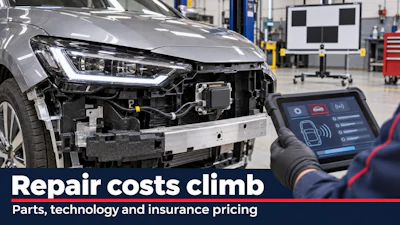
When an equipped vehicle does crash, sensors can add replacement and calibration costs. More sophisticated headlights, advanced powertrains and other equipment also contribute to repair expenses, Moore wrote.
U.S. estimating figures show how common calibration work has become. Researchers at Chicago-based claims and repair technology provider CCC Intelligent Solutions reported that 28.3% of repairable estimates included calibrations in 2025.
In the 2026 edition of Crash Course, CCC researchers also described how higher deductibles and household financial pressures affect the claims reaching insurers. Some drivers absorb smaller losses themselves, leaving a greater proportion of expensive claims in insurers’ figures.
An increase in the average claim can therefore reflect both more demanding repairs and fewer minor claims being reported.
Electric vehicle costs draw closer
Canadian figures from estimating and claims technology provider Mitchell show that repair-cost differences between electric and gasoline vehicles are narrowing.
During the second quarter of 2026, average repairable claim costs were $6,645 for battery electric vehicles and $5,411 for gasoline vehicles.
The $1,234 gap was the smallest recorded in Mitchell’s Canadian data. Those figures cover vehicles being repaired, excluding total losses.
Parts selection remains different. Across the estimates examined by Mitchell researchers, original equipment manufacturer parts accounted for 85% of parts dollars for battery electric vehicles, compared with 61% for internal combustion engine vehicles.
Ryan Mandell, vice-president of strategy and market intelligence at San Diego-based Mitchell, said in an Aug. 20 press release that “ongoing trade and geopolitical uncertainty could put renewed pressure on replacement part costs and availability.”
Bigger claims do not always become repair orders
Some damaged vehicles are written off rather than repaired.
In CCC’s U.S. data, total losses reached 23.1% of claims across loss categories in 2025, a record for that dataset. Researchers identified older vehicles, repair costs and changes in claim-filing behaviour as factors affecting whether vehicles were repaired or replaced.
That is a U.S. figure, not a Canadian total-loss rate.
The distinction also affects comparisons between premiums and repair bills.
As previously reported in Collision Repair, General Insurance Statistical Agency figures show Ontario’s average earned collision premium increased 12.6% in 2025, to $508.91. Average collision claim costs rose 0.5%, to $11,735.
Those claim costs include total losses. The $11,735 figure is not the average amount paid to repair a vehicle.
Ontario’s collision loss ratio fell from 73% to 67%, meaning claims and claim-handling expenses represented a smaller share of premiums. Other insurer expenses are excluded, so the remaining share cannot be treated as profit.