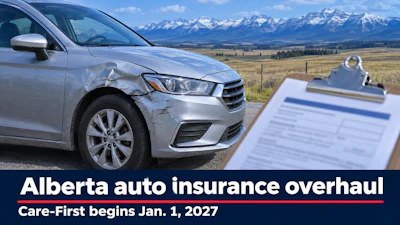
Alberta drivers are receiving renewal notices showing average premium reductions of 13.7% (about $297 per vehicle) under Care-First, an insurance overhaul beginning January 1, 2027, that expands injury benefits while restricting most lawsuits against at-fault drivers.
- Average premium reduction of 13.7% or approximately $297 per private passenger vehicle under Care-First
- New system begins January 1, 2027 with renewal notices issued starting November 1
- Eligible injured people receive prescribed benefits through their own insurer regardless of fault, with no dollar or two-year limits on medical and rehabilitation expenses
- Most injured people lose the ability to pursue ordinary injury lawsuits against at-fault drivers, with limited exceptions for serious offences and third-party claims
- Premium changes vary by driver profile: young male drivers see 30% reduction ($3,094), while all motorcycle profiles show increases of at least 37%
Alberta drivers have begun receiving renewal notices reflecting lower projected premiums under Care-First, an insurance overhaul that will expand injury benefits while restricting most lawsuits against at-fault drivers beginning Jan. 1, 2027.
Insurers began issuing the notices Nov. 1 for policies taking effect Jan. 1 or later. The new injury benefits will apply to eligible collisions occurring from Jan. 1, regardless of an existing policy’s renewal date.
Approved insurer filings indicate an average reduction of 13.7%, or approximately $297 per private passenger vehicle, according to figures released by Automobile Insurance Rate Board officials. Actual premiums will depend on the insurer, vehicle, driving history and coverage purchased.
“Care-First is about making auto insurance work better for Albertans,” said Aaron Sutherland, vice-president, Pacific and Western, at Insurance Bureau of Canada in a press release.
The bureau is the national association representing private home, auto and business insurers. Its representatives attribute the anticipated savings to reduced legal costs under the new system.
Under Alberta’s current system, injured people can receive basic accident benefits and pursue an at-fault driver for additional compensation. Basic medical and rehabilitation benefits generally cover up to $50,000 over two years.
Under Care-First, eligible injured people will generally receive prescribed benefits through their own insurer regardless of who caused the collision. Coverage will continue through private insurers.
Eligible medical and rehabilitation expenses will no longer be subject to the existing overall dollar and two-year limits. Treatment must be reasonable, necessary and meet the requirements for benefits. Expanded income replacement, caregiver and permanent impairment benefits will also be available.
Most injured people will lose the ability to pursue an ordinary injury lawsuit against the at-fault driver. Exceptions include certain serious driving offences, claims against specified third parties and some financial losses exceeding benefit limits.
Claimants will be able to appeal benefit decisions to the Alberta Automobile Care-First Tribunal.
Vehicle damage coverage will continue under existing arrangements. In policyholder guidance, Intact Insurance representatives explain that collision, comprehensive, all-perils and direct compensation for property damage coverage will continue to cover vehicle repairs or replacement as before.
Premium changes will vary between groups. The regulator’s young male driver profile showed a reduction of $3,094, or 30%, while middle-aged driver profiles showed reductions of approximately $525.
All three motorcycle profiles examined by regulator staff showed increases of at least 37%, reflecting the greater expected cost of expanded injury benefits. The profile results are not guaranteed changes for individual policyholders.
Lawyers representing injured claimants have opposed the overhaul. In a March statement, Laura Comfort, chair of the Alberta Civil Trial Lawyers Association, questioned whether the proposed premium benchmark adequately accounted for care costs, disputes and access to benefits. Those objections concerned the earlier actuarial costing, before the subsequently approved insurer filings.
Separate rate protections will accompany the transition. Provincial officials have announced a 5% limit on average insurer rate increases and a 10% limit at renewal for eligible individual drivers. Eligibility can change following an at-fault collision, driving conviction or changes to drivers, vehicles or coverage.