Ontario's Vehicle Innovation Network has expanded its automotive technology funding to include defence, dual-use, and space projects, with applications opening October 7 and grants up to $1 million available for eligible businesses developing sensors, electrification, autonomous systems, and satellite technologies.
- Funding Expansion: OVIN now supports defence, dual-use, and space technology projects alongside traditional automotive innovation
- Application Deadline: Expressions of interest for R&D Partnership Fund are due November 4
- Funding Amounts: Up to $100,000 for 12-month projects or $1 million for 24-month projects, with private-sector co-investment requirement of $2 for every $1 in program funding
- New Strategic Partner: McMaster University joins Toronto, Waterloo, Windsor, and Western University as institutional partners
- Eligible Technologies: Sensors, electrification, propulsion, autonomous systems, and satellite technologies for defence, public safety, or space applications
Automotive researchers and industry representatives have gathered in Toronto to discuss new vehicle technology and how businesses can prepare for it.
The ninth annual Ontario Vehicle Innovation Network Partnering Forum took place Oct. 7 at the University of Toronto Conference Centre. Discussions covered electric vehicles, charging, technology testing and new markets.
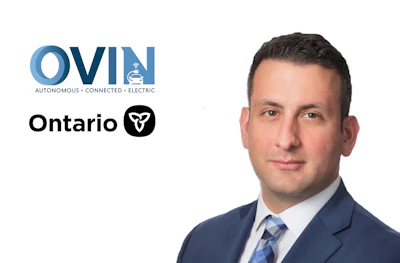
For collision repairers, the changes will reach the shop floor, said Raed Kadri, head of OVIN at the Ontario Centre of Innovation.
“As vehicles become increasingly electric, connected and software-driven, the technologies being developed today will influence how vehicles are diagnosed, maintained, and repaired tomorrow,” Kadri said in written responses to Collision Repair after the forum.
OVIN is an Ontario government initiative run by the Ontario Centre of Innovation. Through its programs, technology developers can access funding, research facilities and partners to help test products and bring them to market.
Bodyshops can also get involved. Kadri said repair businesses could work with developers to test diagnostic tools, repair technologies and artificial intelligence applications.
“A collision repair business developing a new technology or working with an innovator to test a solution may have opportunities to participate,” he said.
Funding depends on the program and the project. Kadri encouraged interested owners to contact OVIN to discuss eligibility.
He identified electric vehicles, AI and connected vehicle systems as three areas that will affect repairs.
“Electric vehicles are changing the skills, equipment and safety procedures required to repair vehicles, particularly when working with high-voltage batteries and electrical systems,” he said.
AI could help technicians find damage and assess vehicle systems. More cameras and sensors also mean more attention to diagnostics and calibration.
“For collision repair businesses, the challenge isn’t simply learning to repair a different type of vehicle,” Kadri said. “It’s preparing for an industry where software, electronics and advanced technologies play a much greater role in the repair process.”
The forum followed two additions to OVIN’s programs. On Oct. 5, McMaster University announced its addition to OVIN Incubators, a program connecting researchers, entrepreneurs and industry partners to develop new businesses. The Hamilton university brings expertise in electric vehicles, manufacturing and connected vehicle technology.
On Oct. 6, officials announced funding eligibility for defence, dual-use and space projects, including work involving sensors, electrification and autonomous systems.
For repairers preparing for new technology, Kadri recommended identifying the skills employees will need, exploring training and connecting with developers. OVIN’s regional technology development sites provide access to technical expertise, research partners and testing resources.
“Workforce readiness is a major priority for OVIN because innovation only succeeds when businesses have access to people with the right skills,” he said.
More information is available on the OVIN website, and through the Regional Technology Development site.