July 2026 US auto sales are projected to reach 1.37 million units at a 16.5 million seasonally adjusted annual rate, maintaining the steady pace established since March and marking a fifth consecutive month above 16 million units, though overall 2026 sales are expected to decline 3% from 2025.
- July 2026 US auto sales projected at 1.37 million units with a 16.5 million SAAR, matching June's pace
- Five consecutive months at or above 16.0 million SAAR represents the longest such stretch in over five years
- Full-year 2026 US auto sales forecast at 15.82 million units, a 3% decline from 2025's 16.38 million units
- Battery-electric vehicles expected to reach 7% of new-vehicle sales in July, showing limited progress despite rising fuel prices
- Market uncertainty around fuel prices and upcoming EV launches later in 2026 will determine future BEV demand momentum
A Mobility Global report predicts new light vehicle sales in July will maintain pace with the previous three months.
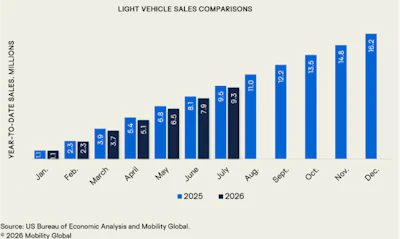
July 2026 US auto sales are projected to reach approximately 1.37 million units, according to Mobility Global. This would represent a 16.5 million seasonally annual adjusted rate (SAAR), matching June and extending the steady sales pace the market has held since March.
For the full year, Mobility Global now forecasts 2026 US auto sales to hit 15.82 million units. This is a decline of over 3% from the 16.38 million units sold in 2025. This is a slight increase over Mobility Global’s prior 2026 sales view, but the bigger takeaway is the direction: the market is settling rather than growing.
“July US auto demand is expected to hold the pace we’ve seen since March,” said Chris Hopson, principal analyst at Mobility Global. “If this plays out, it would mark five straight months at or above a 16.0 million SAAR, the longest such stretch in more than five years. Getting meaningfully above this level will be tough for consumers under today’s conditions. However, after the stop-and-go pattern of 2025, the industry will welcome the consistency.”

Mobility Global expected battery-electric vehicle (BEV) sales and market share to cool in the first half of 2026, as both automakers and buyers adjusted to the market after incentive-driven demand. But rising fuel prices since March have pulled some shoppers back toward fuel-efficient options, including EVs.
BEV share of new sales has improved from the winter chill, but gains remain measured. For July, it is expected that BEVs reach about 7% of new-vehicle sales, reflecting limited progress.
A few forces appear to be tempering new BEV momentum even with higher fuel prices. OEM adjustments (production slowdowns, inventory, strategy) could be constraining availability and used-EV activity appears to be rising, which can satisfy value-focused demand that might otherwise land in new BEVs.
New BEV launches coming later in 2026 should add additional momentum. Still, the market is weighing a key uncertainty: how high fuel prices will rise and how long they will stay there. That will impact how quickly BEV demand can build from here.