Bodyshops can significantly reduce recycling costs by sharing waste pickups through regional collection depots, according to research published in Sustainability. Belron Canada's pilot program increased glass recycling rates from 40% to 54% by consolidating windshield collection across delivery routes.
- Cost reduction strategy: Authorized collection networks gather waste from multiple scattered workshops to lower per-unit collection costs
- Proven results: Belron Canada increased glass recycling from 40% in 2024 to 54% in 2025 using existing delivery routes
- Scalability: The successful pilot expanded to 65% of Belron's branches across British Columbia, Alberta, Ontario, and Quebec
- Research gap: Of 84 studies reviewed, only 4 drew evidence from actual repair shops, highlighting need for real-world trials
- High-value components: Used electronics from vehicle repairs sell for 50-70% of new unit prices, making return programs viable
Bodyshops could spend less to recycle discarded windshields and other parts by sharing pickups, according to a review published in the journal Sustainability.
“Authorized collection networks could gather small quantities from scattered workshops and lower collection costs, although this remains untested,” the authors wrote.
Lead author Nimit Sharma is an assistant professor at REVA University in Bengaluru, India. Co-author Shivasharana Marnur is an associate professor who specializes in operations at the same university. Vijaya Kittu Manda is an interdisciplinary researcher at PBMEIT in Visakhapatnam, India, and Theodore Tarnanidis is a marketing researcher affiliated with the University of Macedonia in Thessaloniki, Greece.
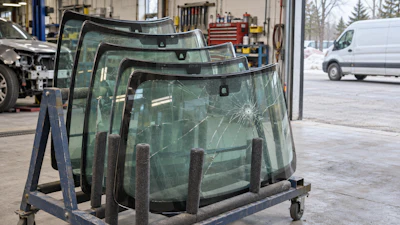
Belron Canada staff have tested a similar approach with discarded windshields. They use existing delivery routes to move the glass from branches to warehouses for recycling.
The Canadian operation’s glass recycling rate rose to 54% in 2025 from 40% in 2024, according to Belron’s sustainability report. After the pilot, staff expanded the program to 65% of the network’s branches in British Columbia, Alberta, Ontario and Quebec.
At the recycler, the plastic layer bonded between the two sheets of windshield glass complicates processing. One study cited in the review separated about 99% of the glass from that layer using windshields from scrapped vehicles. The researchers found little evidence on the cost of collecting and processing windshields removed at repair shops.
The options were more limited for paint booth and prep waste. Researchers have tested treated paint sludge in asphalt and concrete. The review found no studies describing chemical, heat-based or biological recycling methods for spent sandpaper, grinding wheels or rubber and latex protective gear.
“Low-value contaminated consumables require funded collection, because recovered material will not cover the cost,” the authors wrote. “Components with resale or remanufacturing value can support return schemes with smaller subsidies.”
Electronic components are one candidate for return programs. The review cited research showing that tested used or refurbished electronics from dismantled vehicles sold for 50% to 70% of the price of new units. The authors called for trials to see how return programs would work for parts taken out of vehicles during repairs.
Of the 84 reports in the review, 63 were laboratory studies and four drew on evidence from repair shops or the wider automotive service industry. The authors called for researchers to measure what shops generate, what gets collected and where it ends up.
“Landfilling or mixing into general scrap is reported for several streams,” they wrote. “However, its extent across all eight categories is unknown.”