Auto recyclers face critical safety gaps when handling electric and hybrid vehicles, as existing training programs are designed for mechanics and firefighters rather than recyclers dealing with damaged vehicles and heavy equipment. Specialized EV safety training tailored for recyclers is essential to prevent fires, address common misconceptions about battery safety, and build consumer confidence in second-life EV parts.
- Common misconception: Disconnecting the 12-volt battery makes EVs and hybrids safe—this is false, as high voltage can remain present and internal battery damage from accidents is unpredictable.
- Hybrid risk: Hybrids are often more dangerous than fully electric vehicles because they use two fuel sources, yet many recyclers wrongly assume hybrids are safer.
- Real incident: A recycling facility experienced a fire when equipment struck a battery believed to be removed, injuring no one but highlighting the dangers of complacency and poor procedures.
- Team training is essential: Training only one or two employees is ineffective; consistent, hands-on team training builds safety habits and ensures workers respond safely when unexpected situations occur.
- Practical safety steps: Simple changes like staging incoming EVs away from other vehicles, storing batteries on racks in canopies, and covering battery terminals with tape significantly improve yard safety and component reusability.
Electric and hybrid vehicles are entering Canadian salvage yards in growing numbers, but recycler safety practices have not kept pace. Misconceptions persist, such as the idea that hybrids are less dangerous than fully electric vehicles or that pulling a 12-volt battery makes a car safe to handle. Meanwhile, training programs are almost always designed for mechanics, firefighters, or tow operators— not for recyclers, who deal with badly damaged vehicles and heavy equipment on a daily basis.
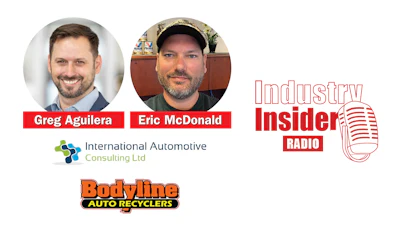
Recognizing this gap, International Auto Consulting founder Greg Aguilera developed a safety certification course tailored for the recycling sector. He recently worked with Eric McDonald, general manager of Bodyline Auto Recyclers, after McDonald’s facility experienced a fire caused by an EV battery. The two spoke to Allison Rogers, host of Collision Repair’s Industry Insider podcast about the challenges recyclers face, what training really needs to cover, and how small changes in practice can make a big difference.
Allison Rogers: Greg, why did you decide to create EV safety training specifically for recyclers?
Greg Aguilera: I’ve been in the auto industry for more than 35 years, and when EVs started showing up in recycling yards, there really wasn’t any guidance. The common response was “don’t touch it.” That mindset is risky. I visited one yard that insisted it didn’t have any EVs, yet it was packed with hybrids. The lack of awareness itself is dangerous. Recyclers need training that reflects their reality—damaged vehicles, heavy machinery and the need to test parts for reuse.
AR: Greg, why is EV and hybrid safety training such a critical issue for recyclers today? Why is it so important they understand the risks?
GA: When EVs first entered the recycling industry, the approach was basically “don’t touch it.” With little meaningful training available, complacency set in—many assume “it won’t happen to me.” Recently, I visited a yard that claimed they had no EVs, yet it was full of hybrids. That mindset is risky. Unlike draining fuel from a tank, you can’t simply remove the energy from a lithium battery. It’s not inherently dangerous, but it does carry risks. Training is key to mitigating those risks and understanding how to handle, test, and determine the reuse or recycling of components. Right now, consumer confidence in second-life EV parts remains low, which slows adoption.
AR: What are the most common misconceptions recyclers hold?
GA: The biggest is that hybrids are safe while EVs are dangerous. In reality, both carry significant risks—hybrids even more so, since they use two fuel sources. Another is believing that disconnecting the 12-volt battery makes the vehicle safe. Fires can ignite quickly, and accident damage means safety systems might already be compromised. Without proper training, workers may approach these vehicles with a false sense of security.
AR: Eric, your yard had a close call with a fire. What happened?
Eric McDonald: We thought a vehicle’s battery had been removed, but a material handler hit it and caused an arc. It started a fire right there in the yard. Nobody was injured, but people panicked. Even with some training, procedures nearly went out the window in that moment. It was a wake-up call: you can’t assume, and you can’t be complacent.
AR: How did that incident change your practices?
EM: We immediately changed how we process hybrids and EVs. Now the batteries come out right away, the vehicles are marked clearly—spray-painted so everyone knows what’s been depolluted—and they’re staged separately from other inventory. Clear markings and consistent processes are essential, especially with multiple people working across the yard.
AR: Greg, what’s missing from the EV training options that already exist?
GA: Most courses aren’t built for recyclers. They don’t cover things like putting a wrecked EV on a hoist with a 20-ton loader or figuring out whether a salvaged component can be safely reused when you can’t just plug in a dealer diagnostic tool. Testing parts is critical for profitability as well as safety, but it’s usually ignored. Our course is designed from the ground up for recyclers, blending safety with practical business needs.
AR: How important is it that entire teams—not just one or two people— receive training?
GA: Training just one employee isn’t enough. Safety is a team effort. Confidence and competence come from repeated, handson practice, and that only works if everyone is on the same page. A certificate doesn’t change a facility—consistent training and process adjustments do.
EM: If your crew only trains once, they’ll forget what they learned. Frequent repetition builds habits, so when something unexpected happens, they respond safely and without hesitation.
AR: Can you outline the main hazards of working with EVs and hybrids, particularly when dismantling or receiving them?
GA: Sure. In a typical recycler scenario, a vehicle arrives from auction, and the first step is de-polluting it. A major hazard is assuming that disconnecting the 12-volt battery makes the vehicle safe—voltage can still be present, and this is often overlooked. Another danger is the battery itself: even if there’s no visible damage, internal trauma from accidents or airbag deployment can make it unpredictable. Unlike a petrol engine, you can’t assume it’s safe once it’s switched off. Complacency is the biggest risk; until the battery is confirmed safe, it must be treated as a potential hazard.
AR: Eric, Greg recently visited your facility. What did you take away from that walkthrough?
EM: It was unbelievable what we covered in an hour. Greg pointed out that our battery storage would be safer on racks in our canopy building instead of inside the warehouse. He also suggested staging incoming EVs away from other cars and buildings, and covering battery terminals with tape to protect against moisture and debris. Simple changes, but they’ve already made our yard safer.
AR: Excellent. So Greg, what did you learn about Eric at Bodyline and his facility?
GA: At Eric’s facility, we reviewed storage for batteries, tools, and cleaning supplies, and used his incident as a learning moment to improve processes. Walking through the yard together gave us great insight into safely managing EVs. I’ve been working with hybrids since 2010 and also do facility and process design. What makes our approach unique is combining safety with profitability. Simple steps, like covering connections, protect both workers and components for resale—high-voltage parts must stay clean to be reusable. Every yard is different, so cookie-cutter approaches don’t work.
AR: Greg, what’s your big-picture advice for recyclers?
GA: Don’t underestimate the risks. Every yard is different, but every yard is vulnerable. The goal isn’t to scare people—it’s to build confidence and competence. Scared people make bad decisions. Training needs to be hands-on and tailored to recyclers’ work. If the industry invests in that, we’ll keep people safe and build consumer confidence in second-life EV parts.
Both Aguilera and McDonald stressed that preparation is the only defense against the unexpected. “Be as prepared as possible— expect the unexpected,” McDonald said. For recyclers, the EV wave isn’t coming. It’s already here.
AR: Do you have any last words that you would like to say to the industry?
GA: If you’re interested in EV training, reach out to me on LinkedIn (Greg Aguilera), via email at [email protected], or through intautoconsulting.com. I’m happy to answer questions and help the industry take a step forward.