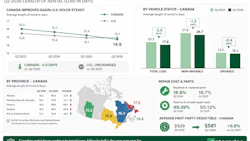

Canadians may be spending more than ever on electric vehicle repairs, but the cost of fixing them isn't rising faster than the cost of fixing ICE vehicles.
Battery-electric vehicles have reached a record 5.42% of repairable collision claims in Canada as the difference between their average repair costs and gasoline-powered vehicles narrows to its lowest level on record.
Mitchell, an Enlyte company that provides collision repair and auto insurance technology and data, reported average repairable severity of $6,645 for battery-electric vehicles in Canada during the second quarter of 2026. That compares with $5,411 for vehicles powered by internal combustion engines, leaving a $1,234 gap across all model years.
Plug-in hybrids averaged $6,227 per repairable claim, while mild hybrids averaged $6,080.
Mitchell officials said higher total-loss frequency and an increasingly mature electric vehicle fleet may be helping narrow the difference between powertrains.
“Historically, BEVs generate higher repair costs due, in part, to more complex, interconnected systems,” officials wrote. “However, Q2 data shows a difference in average repairable severity of just $729 between BEVs and ICE vehicles in the U.S. and $1,234 (CAD) in Canada across all model years.”
The Canadian claims mix is also changing quickly.
Battery-electric vehicles represented 5.42% of repairable claims in the second quarter, up 12.4% year over year. Mild hybrids reached 5.52%, up 27.5%, while plug-in hybrids accounted for about 1.85%, up 27.6%.
British Columbia remained the North American market with the highest battery-electric vehicle repairable claims frequency at 9.34%, followed by Quebec at 9.19%. California ranked third at 7.02%.
Tesla models still account for a large share of Canadian battery-electric collision work. The Model Y represented 23.29% of Canadian repairable BEV claims, followed by the Model 3 at 22.79%. The Ford Mustang Mach-E accounted for 5.16%, the Hyundai Ioniq 5 for 4.45% and the Hyundai Kona EV for 4.08%.
Mitchell’s data also show significant differences in parts use.
Original equipment manufacturer parts accounted for 84.74% of parts dollars on North American battery-electric vehicle estimates, compared with 61.44% for internal-combustion vehicles. The BEV figure fell 1.72 percentage points from the first quarter.
Repairers fixed rather than replaced 14.81% of parts on battery-electric vehicle estimates, compared with 16.60% for internal-combustion vehicles. The BEV repair share increased 1.83 percentage points from the first quarter.
Average first-party deductibles were also higher for battery-electric vehicles at $784, compared with $648 for internal-combustion vehicles. The BEV figure increased 4.12% from the previous quarter.
Separate Canadian collision repair data have also recorded lower repair values in recent months.
The July Pulse of the Industry report from Collision Repair magazine and Vancouver-based AutoHouse Technologies found average insurer-paid repair-order values had declined month over month by $100 in April, $50 in May and $131 in June, for a cumulative $281 decline between March and June.
Mike Gilliland, president and founder of AutoHouse Technologies, said the July result extended that trend.
“This is no longer a short term movement, the most recent three months show a sustained downward trend, and the average RO value is also below July 2025,” Gilliland said.
Pulse of the Industry covers the broader Canadian collision repair market rather than separating repair orders by powertrain. The report draws on more than 60,000 Canadian repair orders each month.
Through the spring, lower repair values in that dataset were accompanied by improving production measures. Average cycle time fell from 13.8 days in April to 13.2 days in May and 13.1 days in June, while touch time increased from 2.5 hours per repair per day in April to 2.6 hours in May and June.
The work-in-progress ratio also declined from 12.7:1 in February to 10.5:1 in June.
Mitchell’s U.S. results differed from Canada. Battery-electric vehicles remained at 3.32% of U.S. repairable claims during the second quarter, while mild hybrids reached a record 5.83%, up 26% year over year.
Mitchell officials also cited tariffs, the review of the United States-Mexico-Canada Agreement, aluminum supplies and global shipping disruptions as factors that could affect future parts costs and availability.