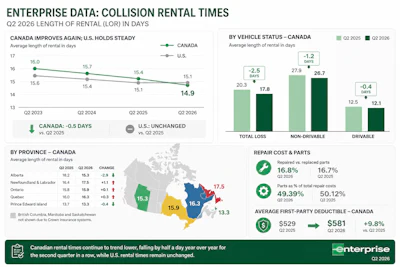
Canadian collision-related rental times fell to 14.9 days in Q2 2026, down half a day from the previous year and now outpacing the United States at 15.1 days. The improvement was driven by significant reductions in total-loss and non-drivable vehicle claims, with total-loss rentals dropping 2.5 days to 17.8 days.
- Canadian collision rentals averaged 14.9 days in Q2 2026, down from 15.4 days a year earlier
- Total-loss claims showed the largest improvement, falling 2.5 days to 17.8 days
- Canada now leads the U.S., which remained flat at 15.1 days in Q2
- Alberta recorded the biggest provincial improvement with rental times falling 2.9 days to 15.3 days
- Average first-party deductibles rose nearly 10%, from $529 to $581 year-over-year
Canadian collision-related rental times have continued to fall, dropping below the U.S. average in the second quarter.
Enterprise Mobility data show Canadian collision-related rentals averaged 14.9 days in Q2 2026, down half a day from 15.4 days a year earlier. U.S. rentals averaged 15.1 days, unchanged year over year.
The results leave the two markets just 0.2 day apart. Canadian length of rental has now fallen by half a day year over year in two consecutive quarters, while the U.S. result showed no further improvement from Q2 2025.
The Canadian improvement was strongest among more severe claims.
Rentals associated with total losses averaged 17.8 days, down 2.5 days from Q2 2025. Non-drivable claims fell 1.2 days to 26.7 days, while rentals associated with drivable vehicles averaged 12.1 days, down 0.4 day.
Results varied considerably by province.
Alberta recorded the largest improvement, with average rental time falling 2.9 days to 15.3 days. Newfoundland and Labrador moved in the opposite direction, increasing 1.1 days to a national high of 17.5 days.
Ontario edged upward by 0.1 day to 15.9 days, while Quebec increased 0.3 day to 16.3 days. Prince Edward Island recorded the shortest average rental period at 13.3 days.
Enterprise does not publish provincial figures for British Columbia, Manitoba or Saskatchewan because of the Crown insurance systems in those provinces.
The shorter Canadian rental periods came despite little change in the proportion of damaged parts being repaired rather than replaced.
Ryan Mandell, vice-president of strategy and market intelligence at Mitchell International, said repaired parts represented 16.8% of the Canadian total in Q2, compared with 16.7% a year earlier.
Parts accounted for 49.39% of total Canadian repair costs, down from 50.12% in Q2 2025. Mandell said relatively modest Canadian inflation over the past 18 months may help explain why parts have not taken a larger share of repair costs. He cautioned that higher global parts prices could begin reaching Canada later this year and in 2027.
Canadian drivers are also carrying larger deductibles. The average first-party deductible rose nearly 10%, from $529 in Q2 2025 to $581 this year.
“The impact of higher insurance premiums is still working its way through the Canadian ecosystem,” Mandell said.
He said higher insurance costs could contribute to further reductions in claim volumes, particularly among lower-severity collisions.
The latest figures show Canadian collision rental times continuing to improve even as progress in the U.S. has levelled off. Canada now has the shorter overall average, though provincial results remain uneven and non-drivable claims continue to keep customers in rentals far longer than drivable repairs.