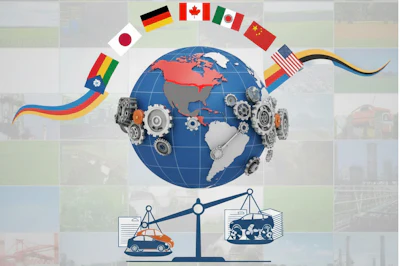
Canada relies on voluntary, industry-led EV battery recycling programs while the United States, European Union, and United Kingdom have implemented or are implementing mandatory regulatory frameworks that assign clear legal responsibility for battery collection, recycling, and material recovery.
- Canada has no federal regulation governing EV battery collection, transport, or recycling, with inconsistent provincial policies across the country.
- The EU Batteries Regulation mandates recycling efficiency targets, minimum recovery rates for lithium, cobalt, and nickel, and digital battery passports tracking each battery's lifecycle.
- California's Senate Bill 1215 (effective January 1, 2026) introduces point-of-sale recycling fees and clearly defines manufacturer and recycler responsibilities for embedded batteries.
- Canada's national EV Battery Recovery Program (launched June 2025) operates on an opt-in basis with no federal requirement for automaker participation or legislated backup if coverage gaps emerge.
- Industry leaders warn that without defined regulatory responsibility, Canadian recyclers face liability, safety, and storage risks as EV volumes increase in the recycling stream.
Toronto, Ontario -- While Canada continues to rely on voluntary, industry-led programs to manage end-of-life EV batteries, regulators in the United States, Europe and the United Kingdom are moving toward formal systems that assign clear legal responsibility for recycling and material recovery.
Canada still has no federal regulation governing the collection, transport or recycling of electric vehicle batteries.
Provincially, policy remains inconsistent. British Columbia previously signalled it would add EV batteries to its extended producer responsibility framework by 2026, then reversed course, opting not to regulate EV batteries at this stage. Quebec considered a similar move in 2021 but abandoned the proposal following industry consultations. Ontario's government has said it does not plan to include EV batteries under its producer responsibility rules, citing voluntary diversion initiatives and the expectation that batteries will not enter landfill streams.
The national EV Battery Recovery Program, launched in June 2025, operates on an opt-in basis, offering free pickup and downstream recycling for participating organizations.
Under the current model, dismantlers typically remove EV batteries, store them on site under safety guidelines and arrange collection through the voluntary program. There is no Federal requirement compelling automakers to participate and no legislated backstop if coverage gaps emerge. Much of the processing capacity remains outside Canada, adding complexity to logistics and long-term planning.
That lack of regulatory certainty has been a recurring topic of discussion for the nation's auto recyclers for some time. In a July 2024 interview, Automotive Recyclers of Canada executive director Wally Dingman said that the absence of clear rules will leave the industry exposed as EV volumes rise.
“We’re seeing more electric vehicles coming into the recycling stream, and the regulatory framework simply isn’t there yet,” Dingman said at the time. “Without defined responsibility, recyclers are left managing liability, safety and storage issues on their own.”
In the United States, policy remains fragmented, but California is pushing toward clearer obligations. Senate Bill 1215, which takes effect January 1, 2026, expands recycling requirements to products with embedded batteries and introduces a point-of-sale recycling fee. Responsibility shifts depending on who removes the battery, creating defined duties for manufacturers and recyclers.
Discussing the intent of the legislation in August 2023, California state senator Ben Allen said the goal was to remove ambiguity from the system.
"Batteries should not be ending up in landfills or creating safety hazards because no one knows who is responsible,” Allen said. “This bill makes that responsibility clear.”
Europe has gone further, adopting a comprehensive regulatory framework that is already reshaping global battery supply chains.
The European Union’s Batteries Regulation establishes mandatory recycling efficiency targets, minimum recovery rates for lithium, cobalt and nickel and a digital battery passport tracking each battery throughout its life cycle.
In July 2023, European Commission vice-president Maroš Šefčovič said voluntary approaches were no longer sufficient as EV adoption accelerates. “These rules ensure batteries placed on the EU market are sustainable, circular and safe throughout their entire life cycle,” he said. “That includes what happens when they reach end of life.”
The United Kingdom, while no longer part of the EU, is moving in a similar direction. The UK government is consulting on reforms to its battery waste regulations, including expanded producer responsibility and stricter reporting requirements for EV batteries.
In a February 2024 policy briefing, a Department for Environment, Food and Rural Affairs spokesperson said the objective is to ensure battery waste is “managed consistently and at scale” as electrification increases.