The U.S. National Highway Traffic Safety Administration proposed delaying the automatic emergency braking standard deadline from September 1, 2029, to September 1, 2031, citing slower-than-expected technology progress and preliminary test failures showing nine of ten 2025 vehicles hit targets in collision scenarios.
- New deadline: Sept. 1, 2031, for most automakers; Sept. 1, 2032, for small-volume manufacturers
- Current deadline: Sept. 1, 2029, for automatic emergency braking compliance
- Test results: Nine of ten 2025 model vehicles hit targets in at least one scenario; none avoided contact in all pedestrian test speeds
- Expected impact: Standard projected to save 360+ lives and prevent 24,000+ injuries annually once implemented
- New requirements: Two dashboard warning tests for system faults, including electrical fault detection within 15 seconds
U.S. safety regulators are proposing to give automakers until Sept. 1, 2031, to meet a federal standard for automatic emergency braking. The proposal also sets out two tests for the dashboard warning that alerts drivers when the system develops a fault.
The National Highway Traffic Safety Administration announced the proposal Nov. 24 and published it in the Federal Register Nov. 27. The current deadline for most manufacturers is Sept. 1, 2029. Small-volume manufacturers and companies that complete or modify new vehicles would have until Sept. 1, 2032, under the proposal.
The standard, adopted in 2024, covers passenger cars and other light vehicles with a gross vehicle weight rating of 4,536 kg (10,000 lb.) or less. It requires forward collision warnings and automatic braking for vehicles and pedestrians. To pass, vehicles must avoid hitting targets in prescribed tests, including pedestrian tests in daylight and darkness.
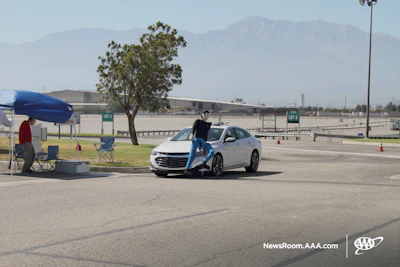
In preliminary tests of 10 model-year 2025 vehicles, nine hit the target in at least one scenario involving a vehicle slowing ahead. None avoided contact at every speed tested in the pedestrian scenarios. The agency said the sample was small and did not represent the fleet.
“The technology has not progressed as much as expected,” said Jonathan Morrison, the agency’s administrator. Cathy Chase, president of Advocates for Highway and Auto Safety, called the proposal “an unnecessary delay that further imperils the safety of all who use our roadways.” When it adopted the standard in 2024, the agency projected it would save at least 360 lives and prevent at least 24,000 injuries a year.
The 2024 standard already calls for a dashboard warning when the braking system detects a malfunction. Under the proposed tests, regulators would introduce an electrical fault before startup in one test and while the vehicle is running in the other. They would check for a warning within 15 seconds, confirm it stays on after a restart if the fault persists and check that it clears once the system is restored. The agency is also asking how it should test for blocked sensors and how often braking systems activate when they should not.
Transport Canada consulted on mandatory automatic emergency braking in 2020 and continued testing the technology on light and heavy vehicles in 2025–26. Canada has yet to adopt an equivalent light-vehicle standard. For Canadian bodyshops, calibration depends on the vehicle maker’s repair procedure. On a 2024 Honda Accord, for example, I-CAR lists a front bumper cover repair within 300 mm (about 12 in.) of the forward radar unit as a reason to calibrate it.