Calibration work has surged to appear on 29.9% of U.S. repair estimates as insurance claims decline and more motorists pay for repairs themselves, with CCC Intelligent Solutions releasing new calibration guidelines to help repairers and insurers integrate manufacturer-specific ADAS requirements into their estimating workflows.
- Calibration surge: Calibration work appeared on 29.9% of repairable appraisals in Q1 2026, up from 23.3% a year earlier, while scans increased to 74.8%
- Claims market shift: Reported claims frequency declined 3.5% through September, with repairable estimate volume falling 5.4% while total losses increased 1.1%
- Customer-paid growth: Customer-paid repair orders accounted for 26% of all repair work, averaging $1,941 compared to $4,821 for insurance claims
- Higher deductibles: Deductibles of $1,000 or more now apply to 28.4% of collision claims, up from 25.7% a year earlier, pushing more repairs to customer payment
- Total loss trend: Nearly one in four claims became write-offs (23.5%), with 11.2% of driveable vehicles flagged as total losses in the first half of 2026
Calibration work has been appearing on a growing share of U.S. repair estimates as insurance claims decline and more motorists pay for repairs themselves.
CCC Intelligent Solutions announced calibration guidelines on Oct. 20, bringing recommendations from calibration and diagnostics providers into estimating software used by repairers and insurers. The Chicago-based company supplies claims, estimating and repair management technology connecting more than 35,000 businesses.
The announcement follows the Oct. 15 release of CCC’s Crash Course 2026 Mid-Year Update. In the first quarter, 29.9% of repairable appraisals included a calibration, up from 23.3% a year earlier. Scans appeared on 74.8%, compared with 70.9%.
The timing of those operations differed sharply. More than 83% of scans appeared on the initial estimate, while just 47% of calibrations were captured there. Among appraisals through insurer direct repair programs, 40.6% included calibrations and 89.8% included scans.
Calibration Guidelines brings provider recommendations, informed by vehicle manufacturers’ repair and calibration requirements, into those estimating workflows. Participating diagnostics and calibration technology suppliers include asTech through adasThink, Azimuth, Opus through ADAS Map Pro, Kinetic and Revv.
Customers need a contract with a participating provider to access recommendations through the Diagnostics button in CCC ONE. There is no additional charge from CCC for the capability. Insurers using Advanced or Intelligent Estimating in CCC’s APEX platform can also access it.
The information exchanged goes beyond identifying the vehicle. CCC’s January 30 software release notes describe sending estimate details, including line labour hours, to configured providers. Returned recommendations can carry the provider’s own procedure description into the estimate.
Opus IVS, a diagnostics equipment and software supplier, describes ADAS Map Pro as a repair planning system that connects vehicle-specific requirements with CCC ONE. Its functions include flagging missing scans, calibrations and consumables, exporting selected estimate lines and sharing information with outside calibration providers.
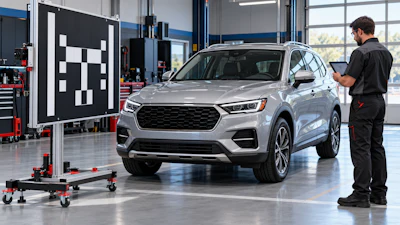
Identifying calibration requirements and completing the work are separate steps. Advanced driver assistance systems, or ADAS, use cameras and sensors for functions such as lane keeping and adaptive cruise control.
Static calibration takes place with the vehicle stationary, often using carefully positioned targets. Dynamic calibration requires driving under specified conditions. Some systems require both. Clearing diagnostic trouble codes is a separate operation. These distinctions are explained in technical guidance from I-CAR, the not-for-profit collision repair training organization.
Canadian repairers already use participating providers’ research tools. In a case study published by Revv, Michael Frangione of Ottawa’s Essential Auto Calibration & Glass described sharing calibration reports with partner bodyshops, which then supplied the documentation to insurers.
The wider claims market is changing alongside that electronic workload.
Through September, reported claims frequency declined 3.5%, compared with an 8.3% decline over the corresponding period in 2025. Repairable estimate volume fell 5.4%, while total loss valuations increased 1.1%.
The Crash Course update draws on U.S. electronic appraisals transmitted through CCC’s network and total loss valuations processed through its systems. Claims figures extend through September, while much of the cost and vehicle analysis covers the first half of 2026.
Customer-paid work accounted for 26% of repair orders in the first half, up 0.5 percentage points from a year earlier. Those jobs averaged US$1,941, compared with US$4,821 for repairable insurance claims.
More than 71% of customer-paid orders were below US$2,000. Approximately 75% of insurance repairs exceeded that amount. Vehicles six years old or newer represented approximately 56% of customer-paid orders, almost matching their share of insurance repairs.
Higher deductibles have increased the amount motorists must pay towards a covered repair. Deductibles of US$1,000 or more applied to 28.4% of repairable collision claims, compared with 25.7% a year earlier and 20.3% in the first half of 2022.
Small insurance repairs also became less common. Approximately 20% of repairable collision and comprehensive claims were below US$2,000, down from around 35% in 2020.
Nearly one in four claims became a write-off. Total losses represented 23.5% across all loss categories through the second quarter, up 0.8 percentage points year over year.
Among driveable vehicles, 11.2% were flagged as total losses in the first half, compared with 6.3% in 2022. Vehicles at least seven years old accounted for 74.3% of total loss valuations. Lower vehicle values leave less room for repair costs before a claim becomes an economic total loss.
Average repair costs increased just 0.6% to US$4,821 in the first half, but remained well above the approximately US$3,331 recorded in 2020. Average part prices were still approximately 8% higher year over year through early 2026, while labour rates increased 1.5%. Fewer parts and labour hours per claim helped limit growth in the overall bill.
Hybrids accounted for 19% of repairable claims involving vehicles three years old or newer in the second quarter—twice the battery electric vehicle share of 9.5%. Average repair costs for those hybrids reached US$6,415, just US$435 below the EV average.
Dan Risley, vice-president of CCC’s Automotive Services Group, described the aim of the calibration initiative.
“CCC is helping make trusted calibration guidance easier to access and apply as repair and claims decisions are being made.”