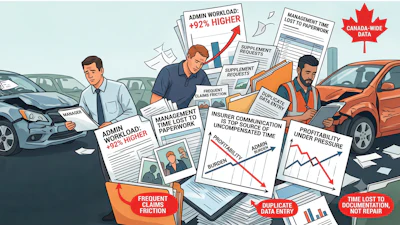

The CRM Collision Repair Index reveals that Canadian collision repair shops are struggling with rising administrative workload, with 92% reporting increased paperwork over two years and over 70% of management time devoted to uncompensated administrative tasks rather than production, directly contributing to widespread profitability decline.
- 92% of collision repair professionals report administrative workload has increased significantly over the past two years, with only 3% experiencing a decrease.
- More than 70% of shop managers estimate at least 31% of their time is spent on administrative responsibilities, with over one-third spending more than 40% on paperwork.
- Insurer communication is the largest source of uncompensated admin work at 59%, followed by supplement preparation (53%), photo documentation (50%), and OEM research (46%).
- Over 75% of respondents report disputes with insurers over required repairs at least weekly, with nearly one-third experiencing daily disagreements.
- The administrative burden spans all shop types and regions across Canada, indicating this is a structural industry issue rather than an isolated problem.
Two surveys into the CRM Collision Repair Index, a clear picture is emerging of an industry buried in paperwork and paying for it at the bottom line.
Earlier in 2026, Collision Repair magazine launched the CRM Collision Repair Index, a national benchmarking initiative built to measure the business conditions facing Canada's collision repair industry. Rather than relying on anecdotal conversations or isolated experiences, the index gives the industry a consistent, recurring snapshot of the pressures shaping repair facilities from coast to coast. Each edition examines a single operational challenge while building toward a longer-term benchmark of the industry's health, one that will let repairers, suppliers, insurers and policymakers track changing conditions and spot emerging trends backed by Canadian data.
The response so far has been encouraging. The inaugural survey, Profitability Pressure, attracted nearly 100 responses from collision repair professionals across the country. The second, Claims Friction and Administrative Burden, drew even greater participation with 102 completed responses. Together, the first two editions have produced more than 200 responses from owners, managers, estimators and business leaders. That is only a fraction of Canada's approximately 4,000 collision repair facilities, but it is enough to offer meaningful insight into what is actually happening on shop floors across the country, and the sample will keep growing with every edition the Index publishes.
The first survey found an industry under real financial strain. More than two thirds of respondents reported profitability had declined over the previous 12 months, and insurer pressure, labour costs and administrative workload emerged as the three biggest threats to business performance. At the time, administrative workload was one pressure among several. The second survey suggests uncompensated admin work may be doing the most damage, and helps explain why.
92% of respondents to the second survey said administrative workload is higher than it was two years ago and three quarters described that increase as significant. Only 3% said the load had gone down. Viewed alongside the profitability findings, the results suggest growing paperwork has become a measurable, ongoing contributor to the financial pressure facing Canadian repair businesses, not just background noise.
Asked where they spend the greatest amount of uncompensated administrative time, 59% of respondents pointed to insurer communication, the single largest source. Supplement preparation followed at 53%, then photo documentation at 50%, OEM repair procedure research at 46%, parts procurement at 38%, DRP reporting requirements at 34% and calibration documentation at 33%. The spread suggests the burden is not concentrated in one bottleneck. It runs through virtually every stage of the repair process.
"Updating repair status on multiple programs. We have to log the same information into several different estimating and management platforms just to keep everything current," said a manager at a franchise/ banner collision centre in Alberta, describing a routine that repeats itself on every file. An MSO owner in Ontario pointed to a related frustration further upstream, in the parts data itself. "Part numbers are constantly wrong, and options are constantly missing. Parts are the biggest problem in our industry," they said.
The paperwork is also driving conflict. More than three quarters of respondents reported disputes with insurers over required repair operations at least weekly, and nearly one third said those disagreements happen every day. Only 12% said insurers generally support required repairs without challenge, while nearly a third said support varies significantly depending on which insurer they are dealing with.
"Everything should be repaired following OEM procedures. There would be no argument over what is required and what is not required," said the owner of a franchise/ banner collision centre in Nova Scotia. Others described the volume of documentation itself as the flashpoint. "The constant photo documentation to justify repairs. Pulling, frame setup, before primer, pre-paint and paint photos. It never ends," said an MSO owner in Alberta. A shop manager in Nova Scotia framed it as a trust problem more than a process problem, saying insurers need to trust that shops are completing repairs as required rather than demanding repeated proof through an ever-growing volume of in-progress photos.
That growing burden is increasingly falling on the people who are supposed to be running the business, not just the technicians on the floor. More than 70% of respondents estimated that at least 31% of management time is now devoted to administrative responsibilities rather than production, and more than one third said paperwork consumes over 40% of management time. Every additional hour spent on documentation and approvals is an hour unavailable to move repairs through the shop, and for many owners it is time spent instead of the work that actually pays.
Money, and the lack of it, ran through nearly every comment. "The problem isn't the documentation. We just need to be compensated properly for our time and knowledge at the administrative level," said an independent shop owner in British Columbia. Another independent shop owner in Alberta put it more bluntly: there is no single requirement they would eliminate, because their shop has effectively absorbed almost the entire administrative relationship with insurers, from the first call with the policyholder through to final estimate approval. A franchise/banner shop in Ontario summed up the frustration that showed up again and again in the written comments: shops attach all the required documentation, follow every procedure, and still have to argue to get paid.
The findings held consistently across every type of operation surveyed. Independent shops made up the largest share of respondents, followed by franchise and banner collision centres, MSOs and dealer collision centres. Regardless of size or ownership structure, the pattern was the same: rising administrative load, frequent friction over required procedures and management time increasingly consumed by paperwork rather than production. Respondents also pointed to inconsistent insurer processes as a major source of inefficiency, describing duplicate data entry across multiple estimating, claims and management platforms and calling for greater consistency in documentation requirements across the industry.
The geography told a similar story. Respondents represented every region of the country, with Ontario, Alberta and Saskatchewan accounting for the largest share of participants, and further responses from Nova Scotia, British Columbia, Quebec, Manitoba, New Brunswick and Prince Edward Island. The complaints were not confined to one province or one type of insurer relationship. They showed up in independent shops on both coasts, in franchise operations across the Prairies and in MSOs running multiple locations, suggesting the administrative burden is a structural issue rather than a regional or company-specific one.
For an industry already contending with tight margins, the implications reach beyond time management. Every hour spent chasing a supplement approval or re-uploading a document already on file elsewhere is an hour a shop cannot bill, and the survey suggests those hours are adding up across the country, not just in isolated cases. For insurers, the findings point to an opportunity as much as a criticism. Greater consistency in documentation requirements, and less duplication across competing platforms, would reduce friction for claims staff and repairers alike. For the shop owners describing the problem in their own words, the more immediate question was simpler: who pays for the paperwork required to prove a repair was done right?
Taken together, the first two editions of the CRM Collision Repair Index tell a connected story. The first identified profitability as the industry's biggest business concern. The second points to one of the underlying causes. As repair procedures grow more sophisticated and documentation requirements continue to expand, many repairers say the challenge is no longer just repairing vehicles correctly. Increasingly, it is managing the administrative process required to repair them properly, document every step along the way and get paid fairly for the work performed. Paperwork that used to be a cost of doing business now looks, for a growing number of Canadian shops, like a business problem in its own right.
Future editions of the CRM Collision Repair Index will continue tracking the issues shaping Canada's collision repair industry, building what Collision Repair magazine intends to become the country's definitive benchmark of repairer sentiment and business conditions. Each new wave will add to the picture already emerging from the first two, and each will give repairers, insurers and suppliers a clearer, more current read on where the pressure is actually coming from rather than where it is assumed to be. Two surveys in, the message from the shop floor is consistent and getting louder. Canadian repairers are not asking for less accountability, and none of the respondents suggested cutting corners on documentation that protects consumers or supports proper repairs. They are asking to be paid for the time it now takes to prove they have earned it.