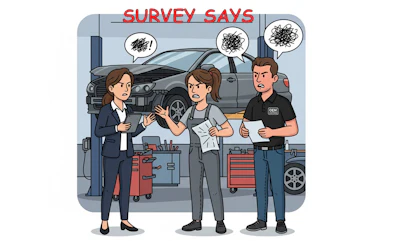

A national survey of collision repair professionals found that insurers, bodyshops, and OEMs all claim high confidence in understanding OEM repair requirements, but the real problem isn't knowledge—it's how each group interprets, accesses, and applies those rules differently in daily operations. The industry's next challenge is achieving alignment in implementation rather than increasing understanding.
- Knowledge vs. Alignment Gap: All three sectors rated themselves highly knowledgeable about OEM procedures, but persistent misalignment exists in how they apply them daily.
- Top Friction Points: Documentation access across multiple OEM portals, ADAS and calibration uncertainty, interpretation differences, cost pressures, and regional enforcement variations.
- Survey Details: 54 responses (63.8% collision repairers, 21.3% insurers, 4.3% OEM reps) generated over 120 written comments revealing consistent industry pain points.
- Implementation Bottlenecks: Shops struggle with repeated documentation requirements, insurers face access and verification challenges, and everyone wants clearer, more consistent OEM communication.
- Path Forward: Industry experts agree the solution requires clearer OEM guidelines, better insurer education, improved communication, and consistent interpretation standards across all parties.
Toronto, Ontario -- Everyone in the collision repair ecosystem insists they understand OEM repair requirements — insurers, bodyshops and OEMs alike. But the rules aren’t the problem. The real battle is how each group applies them.
A new national survey shows high confidence across all three sectors, yet more than 120 written comments reveal an industry still clashing over access, interpretation and the practical realities of OEM compliance on real repairs.
But that shared confidence doesn’t translate into shared execution. Across OEMs, collision repairers and insurers, the survey exposes persistent misalignment in everyday repair decisions — not because people don’t understand OEM rules, but because they interpret, access and apply those rules differently. Documentation bottlenecks, conflicting expectations and practical constraints continue to shape how OEM procedures land on the shop floor.
The survey captured 54 responses from shops, insurers, OEM representatives and other industry professionals, generating more than 120 written comments. While not a statistical sample, the volume and consistency of the feedback offer a clear signal of where the industry’s real friction points lie — and why they keep resurfacing.
Who Responded?
Of the usable responses:
- Collision Repairers: 34 (63.8 percent)
- Insurers: 11 (21.3 percent)
- OEM representatives: 2 (4.3 percent)
- Other professionals: 7 (10.6 percent)
The responses reveal a remarkably consistent set of themes, regardless of category.
Everyone Claims Knowledge — So Why the Disconnect?
One of the most surprising findings is just how confidently each group rated its own understanding of OEM procedures. Insurer respondents overwhelmingly selected “very knowledgeable” or “somewhat knowledgeable”, challenging the stereotype that insurers lag behind in this area. Collision repairers and OEM reps also rated themselves highly.
The problem, then, is not knowledge — it is alignment.
The survey comments point to a web of competing pressures:
- Documentation access issues, especially across multiple OEM portals
- Interpretation differences between insurers and shops
- Calibration and ADAS uncertainty
- Cost pressures affecting approval decisions
- Workflow constraints on both sides of the estimate
- Regional variation in how OEM requirements are enforced
- Portal complexity and subscription burden for smaller shops
One insurer captured the tension:
“We know the OEM procedures. The issue is access and practicality—repairs can’t start when we can’t verify steps for each OEM.”
A bodyshop counterpoint echoed the same strain from the other side:
“We follow OEM instructions, but we spend too much time proving procedures that should be understood industry-wide.”
These aren’t knowledge gaps. They’re implementation gaps.
Where the Industry Gets Its Information
Respondents listed a mix of technical and contextual information sources.
Technical sources included:
- OEM repair portals
- Third-party databases
- I-CAR and OEM training
- Certification program resources
Contextual or supporting sources included:
- Trade publications
- Newsletters
- Conferences
- Peers, networks and OEM meetings
- Insurer bulletins
Trade media — including Collision Repair — appears within this broader “industry understanding” group. Respondents rarely name specific publications in open-ended questions but consistently reference industry news, email updates, trade magazines and events coverage.
Key Themes in the Comments
After analyzing the more than 120 written responses, three dominant patterns emerged:
1. ADAS and calibration challenges
Shops and insurers alike highlighted unclear calibration requirements and inconsistent insurer approval pathways.
2. Documentation and access friction
Insurers want documentation presented consistently. Shops want insurers to recognize OEM standards without repeated explanations. Everyone wants easier access across OEM portals.
3. Certification and cost pressures
While respondents agree OEM certifications are important, shops expressed concern about ongoing investment without insurer alignment or consumer recognition.
An OEM representative summarized the structural issue:
“OEMs need more consistent communication across regions.”
Another cross-industry respondent added:
“Everyone needs to be on the same page—clearer OEM guidelines, more insurer education and better communication would benefit the client most.”
The Big Picture
The survey offers a striking insight: knowledge is not the dividing line.
All three groups believe they understand OEM repair requirements. The friction lies in how those requirements are applied, interpreted, validated and approved in daily repair decisions.
The industry’s next phase of evolution won’t be about increasing knowledge — but about increasing alignment.
Twenty verbatim comments grouped by respondent category.
BODYSHOP COMMENTS
- “Lack of insurer alignment is the biggest issue. We can follow every OEM instruction, but we spend too much time proving procedures that should be understood industry-wide.”
- “Staff training requirements, cost of certification, equipment and facility investment.”
- “Cost of certification is high, and without insurer alignment it’s hard to show customers the true value of certified repairs.”
- “Clearer guidelines and communication between parties involved.”
- “We need consistent interpretation of OEM procedures by insurers.”
- “Provide universal procedure standards for all models.”
- “Simplify access to OEM documentation. Too many portals and too many logins.”
- “Better communication with insurers regarding pre- and post-scans and calibrations.”
- “Training is expensive. Small independent shops need more help keeping up with OEM programs.”
- “Uniform documentation requirements that insurers accept would save huge amounts of time and frustration.”
INSURER COMMENTS
- “Make the information more readily available. We work with multiple OEMs and don’t have unified access.”
- “We know the OEM procedures. The issue is access and practicality—repairs can’t start when we can’t verify steps for each OEM.”
- “Consistent repair documentation from bodyshops would speed approvals.”
- “Better visibility on calibration requirements. They vary widely and sometimes feel unclear.”
- “Shared training sessions between OEMs and insurers would help a lot.”
- “More clarity on which procedures are mandatory and which are recommended.”
OEM REPRESENTATIVE COMMENTS
- “OEMs need more consistent communication across regions. Some follow procedures strictly, others treat them like suggestions.”
- “Insurers need more education about the importance of following OEM procedures for safe repair.”
OTHER / SUPPLIER / CONSULTANT COMMENTS
- “More collaboration is needed between all parties. Everyone needs to understand the reasoning behind OEM requirements.”
- “Everyone needs to be on the same page—clearer OEM guidelines, more insurer education and better communication would benefit the client most.”