Dealerships are increasingly bringing collision repair services back in-house after decades of outsourcing, recognizing it as a critical driver of customer loyalty and profitability. Research shows collision repair experiences significantly influence vehicle brand loyalty, with dealerships that offer these services reporting up to 35-39% of total profitability from collision operations.
- Dealerships abandoned collision services starting in the late 1980s due to high equipment, staffing, and training costs, but are now reversing this trend.
- Toyota and IHS research found that collision repair experience is the strongest driver of brand loyalty, more influential than initial vehicle purchase or regular service.
- 63% of collision customers replace their vehicle within 18 months, and 68% switch brands if the repair experience is poor.
- Collision repair services contribute 35-39% of total dealership profitability when operated strategically, leveraging parts sales, mechanical work, and sensor calibration.
- In-house collision centers create a one-stop-shop experience that reinforces customer relationships and provide sales opportunities through loaner vehicles and total-loss replacements.
Collision repair services were once a standard part of any dealership operations, something that was expected and a service that complimented the dealership’s sales and maintenance services.
Since the late 1980s dealerships in growing numbers began shedding their collision services, sending that business to independent collision and body shop operations. Many dealerships cited the growing costs of operating a collision service department, from new equipment needed, additional staff and training, and the ever growing technological advancement of vehicles that further added costs to maintaining the operation.
Where a simple ‘fender bender’ would several decades back require only that the fender be replaced and colour-matched to the vehicle’s colour. Today, with the advanced vehicle electronics, replacing a damaged fender requires replacing sensors, recalibrating vehicle electronics, use of special paints and more advanced equipment to affect the replacement and staff trained on the
new electronics.
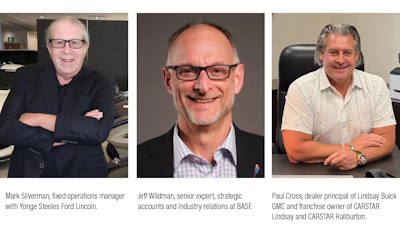
Collision repair services came to be seen as overly complicated, expensive and unprofitable, suggested Jeff Wildman, senior expert, strategic accounts and industry relations at BASF.
“Dealers had this business, but it was treated by many as a ‘dirty little secret,’” Wildman continued. “The last thing they wanted to talk about when trying to sell a new vehicle to someone is when you wreck that vehicle. It does not fit into the whole sales process. When we talk to a customer, we want to talk about service because the reality is many make their money from selling new cars and servicing those cars.”
Over the last decade, that has changed. More dealerships have begun bringing back collision repair services or seeking partnerships with certified collision service providers, Wildman added.
According to Wildman, collision services have come to be seen as a key pillar in maintaining customer loyalty, both to a vehicle brand and a dealership, and a key profit centre when managed and operated strategically.
Collision repair as a loyalty engine
Wildman pointed to a study by Toyota with IHS that “found that the strongest driver of brand loyalty was the collision repair experience, more so than when the vehicle was purchased or the service experience.”
Mark Silverman, fixed operations manager with Yonge Steeles Ford Lincoln has operated an in-house collision repair centre for some 60 years and found that offering collision repair services keeps customers loyal to his dealership and vehicle brands.
 Yonge Steeles Ford Lincoln has operated an in-house collision repair centre for more than 60 years, offering customers certified repairs alongside vehicle sales, service and parts.
 Mark Silverman says the certified facility reinforces customer confidence long after the vehicle sale.
“It actuates the customer relations,” he said. “We become a ‘one-stop shop’ for customers. We can sell them a car, we can service a car, we can provide parts for a car and we can also, in the unlikely event of a collision, repair their car and return it to factory standards.”
Silverman said his Ford-certified collision shop has invested in state-of-
the-art equipment and invested in a dedicated team, including two painters
and two body technicians working across four bays and two spray bays. The collision centre also has a full-time manager and secretary, allowing the team to focus on delivering the highest quality service to vehicle owners.
For Silverman, the value of his collision service operation isn’t measured solely in body shop revenue. It’s in the continuity of care he provides that reinforces customer loyalty to his dealership operations and the vehicle brands he sells.
Dealers have begun to realize this and how a collision regardless if the accident is minor or significant, impacts customer and vehicle brand loyalty; and how service around collision repair can tip the balance between keeping a customer loyal to a dealership and its vehicle brands or sending that business somewhere else.
“Why jeopardize that long-term relationship by not offering a key service . . . you want to be able to say, "Don't worry, come to us. We can fix it. We can repair that panel, do whatever needs to be done, and then continue to build on that relationship that you've already established earlier with the sale and maintenance of the vehicle you sold them,” Wildman said.
That influence is significant. Wildman pointed to OEM research showing that 63% of customers involved in a collision replace their vehicle within 18 months — and 68% of those switch brands if the repair experience is poor.
“When a dealer doesn't have that collision centre, they've outsourced that experience to someone else and you're counting on an independent that you don't know and that you don't have a relationship with influencing your customer of where they're going to buy their next vehicle.”
Collision repair as profit centre
Paul Cross, dealer principal of Lindsay Buick GMC and franchise owner of CARSTAR Lindsay and CARSTAR Haliburton, has doubled down on operating a collision repair service as part of his dealership operations; first building a new collision centre in 2009, branding it CARSTAR in 2010, and later expanding into a 14,000 sq.-ft. standalone facility.
“Fixed operations are an important contributor for me,” he said. “I look at every department — new, used, parts, collision and service — independently, and my expectation is to have each one profitable.”
According to Cross, in 2025, collision repair contributed 35% of total dealership profitability. In some years, he notes, the number has reached as high as 39%. Cross added this profitability builds on a synergistic combination of parts sales to CARSTAR, mechanical work being sent to the dealership’s service department and necessary system and sensor calibrations performed in house.
“We all leverage off the interests of the collision department,” Cross said. He further added he expects his front-line sales agents to remind new vehicle customers that he offers collision repair services, small and large. When his team delivers a new vehicle to a customer, there is an envelope in the glove compartment for a local towing company the dealership has partnered with.
“The idea is that once they're in an accident, then that vehicle would be bought back to us,” he said “In some cases, if the vehicle's deemed as a total loss, there's a natural intrinsic route to then bring that vehicle owner to our sales department. We've been able to talk to that customer and say, ‘Well, we offer this SUV and this brand,’ and sell them a new vehicle.”
Wildman said this was a major missed opportunity for dealers without collision operations.
“If I have a dealership body shop, it's easy for me to say, ‘Let me call up front and have that salesperson come back here.’” he said. “If it's independent… you want me to call you an Uber?”
Even loaner vehicles can become a sales tool. “You brought in a Ford. I'm going to put you in a new Ford of the same vehicle you're driving,” Wildman said. “Maybe it's time to upgrade.”
 CARSTAR facilities are helping dealerships reconnect with collision repair, turning the service into a key driver of customer loyalty, vehicle brand retention and dealership profitability.
 Dealership service centres play a growing role in collision repair, supporting operations with mechanical expertise, diagnostics and vehicle calibration capabilities.
 With dedicated collision repair facilities and trained technicians, dealership-affiliated operations like CARSTAR Lindsay help ensure vehicles are restored to manufacturer standards while keeping customers connected to the brand.
 Inside the spray booth, technicians use advanced refinishing technology to deliver the precise colour matching and finishes required by today’s vehicles.