A more consistent approach to sharing evidence of completed calibrations under a data standards initiative has been outlined by the Collision Industry Electronic Commerce Association (CIECA).
The association’s Calibration Committee is developing requirements for electronically exchanging calibration information and supporting records between repair facilities, calibration providers, insurers, equipment manufacturers and software companies.
The work concerns advanced driver assistance systems (ADAS), including features such as automatic emergency braking, lane keeping assistance and adaptive cruise control. Their cameras and sensors may require calibration following repairs, component replacement or other operations specified by the vehicle manufacturer.
Dan Dutra, committee chair and senior vice-president of the Collision Career Institute, said the initiative addresses how calibration work is documented and communicated.
“CIECA’s role is not to establish technical calibration procedures or specifications, which remain the responsibility of vehicle manufacturers,” Dutra said.
“Instead, the committee will develop standardized data requirements and electronic communication methods that support consistent documentation and information exchange among collision repair facilities, calibration providers, insurers, equipment manufacturers, software companies and other industry participants.”
Founded in 1994 to address the exchange of estimate information between software platforms, CIECA develops and licenses the standards businesses use to connect their systems. The association does not operate a central database of repair records.
Its calibration initiative addresses information beyond a scan tool’s confirmation that a procedure has finished. Dutra said manufacturer requirements can include prerequisites, equipment setup, measurements and verification steps that also need to be documented.
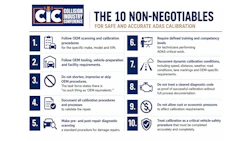
CIECA’s existing calibration workflow illustrates the range of records involved. It identifies manufacturer procedures, evidence that prerequisites were met, technician names, dates and times, scan results and supporting photographs or video.
Depending on the manufacturer’s requirements, preparation can involve checking tire pressures, vehicle loading, ride height and wheel alignment. The workflow also calls for documenting completed calibration procedures and test-drive results.
The distinction between scanning and calibration matters. In published guidance, collision repair training organization I-CAR explains that scanning identifies diagnostic trouble codes, while calibration can involve aiming or teaching systems their required reference positions. Clearing codes alone does not establish that a required calibration was performed.
The latest initiative builds on several years of standards work. CIECA formed its Calibration Committee in 2019. By July 2020, the committee had developed a workflow and updated standards for exchanging estimate and repair-order information. The committee was reactivated in 2022 after industry participants raised further documentation and invoicing concerns.
Minutes from its Nov. 11, 2026 meeting record approval of the current committee’s charter and mission by CIECA’s Standards Advisory Board.
Members also discussed how calibration records could be exchanged through existing and newer software interfaces. Existing standards can carry scan and calibration information within larger records, such as invoices and estimates. Newer interfaces could allow software to request calibration information separately, potentially by vehicle, claim or date.
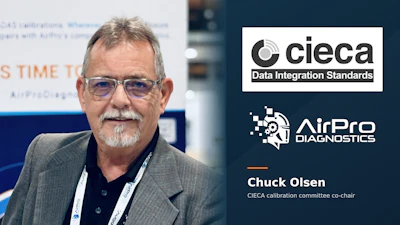
Chuck Olsen, committee co-chair and senior vice-president of automotive technology solutions at AirPro Diagnostics, said the committee intends to work with the Collision Industry Conference’s Definitions Committee and other standards bodies on consistent terminology.
“Common terminology will be important to ensure information is interpreted and shared consistently across different organizations and technology platforms,” Olsen said.
Canadian repairers already face calibration documentation requirements. In British Columbia, the Insurance Corporation of British Columbia (ICBC) instructs collision repair program participants to document reasonable attempts when circumstances outside their control prevent a manufacturer-required calibration.
The ICBC’s guidance also requires participants to inform the customer that calibration remains necessary and that the affected driver assistance systems are not functioning as intended. Supporting records can include appointment availability, the location of a calibration provider or details of vehicle modifications preventing calibration.
CIECA’s stated objectives include simplifying documentation, reducing administrative work and helping businesses assess the records supporting a calibration.
The Nov. 17 announcement did not specify a completion date or implementation timetable. Executive director Paul Barry encouraged participation from across the collision repair and automotive technology industries. CIECA committees include volunteers from both member and non-member organizations.